

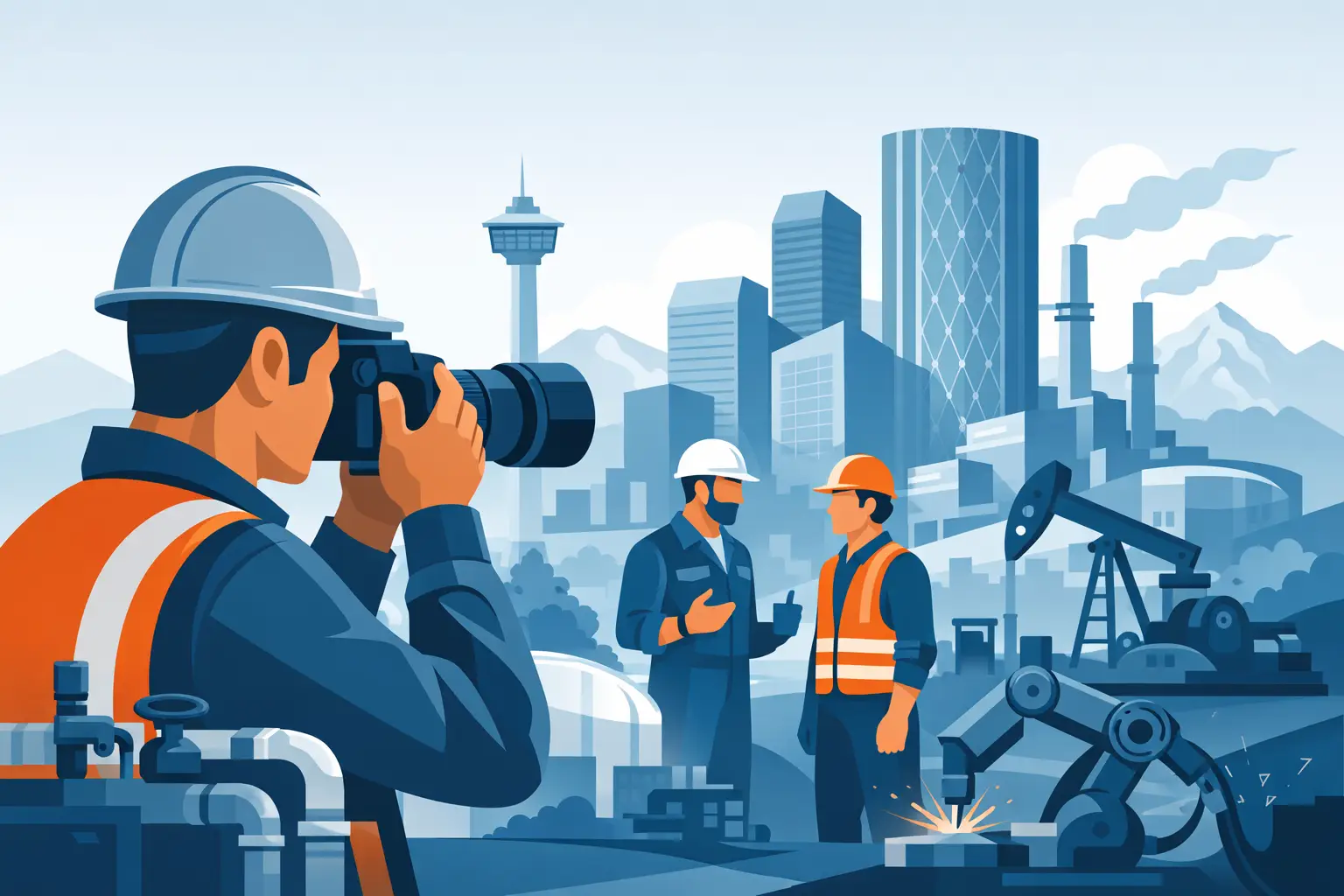
A fabrication floor at 6:30 a.m. looks nothing like it does in a brochure. The light is harsher. The pace is faster. The environment is louder, more complex, and far less forgiving of generic photography. That is exactly why hiring an industrial photographer Calgary companies can rely on is not simply a creative decision. It is a business decision that affects how your operation is understood by customers, partners, recruits, and stakeholders.
Industrial photography has a specific job to do. It needs to document real processes, real people, and real working conditions while still producing polished brand assets. It has to respect safety protocols, move efficiently around active job sites, and create images that feel authentic rather than staged. For industrial brands, the difference between average photography and strategic photography shows up quickly in proposals, websites, recruiting materials, trade publications, and presentations.
What an industrial photographer in Calgary actually brings
Industrial environments are visually demanding. Warehouses, plants, construction sites, logistics yards, and manufacturing facilities all present challenges that do not exist in a controlled studio. Mixed lighting, reflective surfaces, moving machinery, confined spaces, PPE requirements, and limited access windows all affect the shoot.
A skilled industrial photographer in Calgary understands how to work inside those conditions without interrupting operations or losing the visual standard your brand needs. That means more than technical camera knowledge. It means planning around production schedules, understanding where the story lives in the process, and recognizing which images will be useful across marketing and communications.
The strongest industrial photography does not just show equipment. It shows capability. It communicates scale, precision, standards, people, and momentum. A well-framed image of a technician calibrating machinery can say more about quality control than a paragraph of website copy. A portrait of a field team in the actual environment can reinforce credibility in a way stock imagery never will.
Why generic visuals fall short for industrial brands
Many companies rely too long on a patchwork of phone photos, dated site images, and broad stock visuals. It may feel efficient in the short term, but it creates a disconnect. If your website says your company is modern, safety-focused, and highly capable, your photography has to support that claim.
Buyers notice visual inconsistency. So do potential hires. So do investors, agencies, and editors. Weak imagery can make a strong operation look smaller, older, or less organized than it really is. That is not a creative problem alone. It is a perception problem.
This is where a brand-focused industrial photographer Calgary businesses work with can create real value. The goal is not to collect random site photos. The goal is to build a visual library that reflects the brand accurately and gives your team useful assets for multiple channels. That might include hero images for the website, environmental portraits for leadership profiles, process imagery for proposals, recruiting content, editorial-ready photography, and campaign visuals that position your company with confidence.
The balance between authenticity and polish
Industrial photography works best when it respects the reality of the environment. Overdirecting can make a facility feel artificial. Underdirecting can leave the final work flat and unfocused. The right approach sits in the middle.
Authenticity matters because industrial buyers and industry insiders can tell when an image is forced. They know what proper PPE looks like. They notice whether equipment is being handled correctly. They can spot a scene that was staged without understanding the workflow. At the same time, your photography still needs structure, composition, and intention.
That balance is where collaboration matters. Understanding your brand story is the first step to creating images that carry weight. Some companies need to emphasize innovation and technology. Others need to show workforce strength, operational scale, cleanliness, precision, or the human side of the business. The visual priorities shift depending on your market, your customers, and how you want to be positioned.
What to look for in an industrial photographer Calgary company leaders hire
Experience in industrial spaces should be obvious in both the process and the portfolio. You want a photographer who can work comfortably in active environments, communicate clearly with operations teams, and adapt quickly when access, timing, or conditions change.
Just as important, the photographer should think beyond single-use images. Commercial photography performs best when it is planned with broader use in mind. One shoot can support website redesigns, social media, sales collateral, annual reports, recruiting campaigns, and earned media if the shot list is built strategically.
It also helps to work with a partner who understands that different stakeholders often want different things. Marketing may want visually striking brand imagery. Operations may want minimal disruption. Leadership may want polished executive portraits. HR may want culture-focused visuals. A strong commercial team can bring those needs together into one efficient production.
Planning makes the photography stronger
The most effective industrial shoots are rarely improvised. Pre-production shapes the result.
That usually starts with defining what the images need to achieve. Are you repositioning the brand? Launching a new facility? Updating your proposal library? Recruiting skilled labor? Supporting an agency campaign? The answer affects everything from the shot list to location timing to crew needs.
From there, practical details matter. Site access, safety orientation, PPE requirements, permits, weather, shift schedules, cleanup, signage, equipment readiness, and who needs to be on site all influence the day. In industrial settings, a little coordination saves a lot of time.
There is also the question of image style. Some brands want clean, graphic visuals with strong lines and dramatic scale. Others want a documentary feel that highlights people in motion and the texture of real work. Neither is automatically better. It depends on the brand and how the final images will be used.
Industrial photography is also employer brand photography
For many companies, industrial imagery is no longer just about sales. It is also about hiring.
Prospective employees want to see the reality of the workplace before they apply. They want to understand the environment, the team, the equipment, and the level of professionalism. Strong photography can help answer those questions quickly. It can show that your company is organized, safety-conscious, and serious about its people.
This is especially valuable in competitive labor markets. A recruitment page filled with generic stock visuals does very little to build trust. Real images of your crews, facilities, and leadership create a stronger first impression because they give candidates something concrete to respond to.
Safety and credibility are part of the visual story
Industrial brands do not have the luxury of getting the details wrong. One inaccurate image can weaken trust fast.
Photography in these environments has to reflect proper procedures. That includes correct PPE, realistic workflows, and awareness of what should and should not be shown. In some cases, there are confidentiality concerns around proprietary systems, client sites, or restricted areas. In others, there are branding concerns around cleanliness, signage, or equipment condition.
A professional process accounts for those realities without stripping the images of energy. The goal is to create visuals that are credible to industry audiences and compelling to everyone else.
Why local context still matters
A photographer who understands Calgary and the broader Western Canadian industrial landscape brings added perspective. Energy, construction, manufacturing, transportation, agriculture, and infrastructure all shape the regional visual language. There is a difference between photographing a downtown office and photographing a fabrication shop, logistics yard, or field operation outside the city.
Local familiarity can help with pace, planning, and expectations. It also helps when your images need to feel rooted in the region rather than interchangeable with any industrial market in North America.
For companies that need a wider commercial partner, this matters even more. A studio like Image Calgary can approach industrial work as part of a broader brand system, connecting facility photography with portraits, aerials, campaign assets, and other commercial visuals so the final library feels cohesive across every touchpoint.
The real return on better industrial photography
Industrial photography earns its value when it keeps working long after the shoot is over. The strongest image libraries help companies present themselves with more authority, support business development, improve recruiting, strengthen public-facing communications, and give internal teams better tools to work with.
That return is not always immediate in a single metric, and it depends on how the images are used. But the impact is real. Better visuals shape perception faster than most written messaging ever can.
If your operation has evolved, your photography should reflect it. If your team does exceptional work, the visuals should show it with clarity. And if your brand wants to be seen as capable, credible, and current, the right industrial photographer in Calgary can help turn the reality of your business into imagery that earns attention for the right reasons.
The best industrial photography does not make your company look like something else. It gives your audience a sharper, more compelling view of what you already do well.