
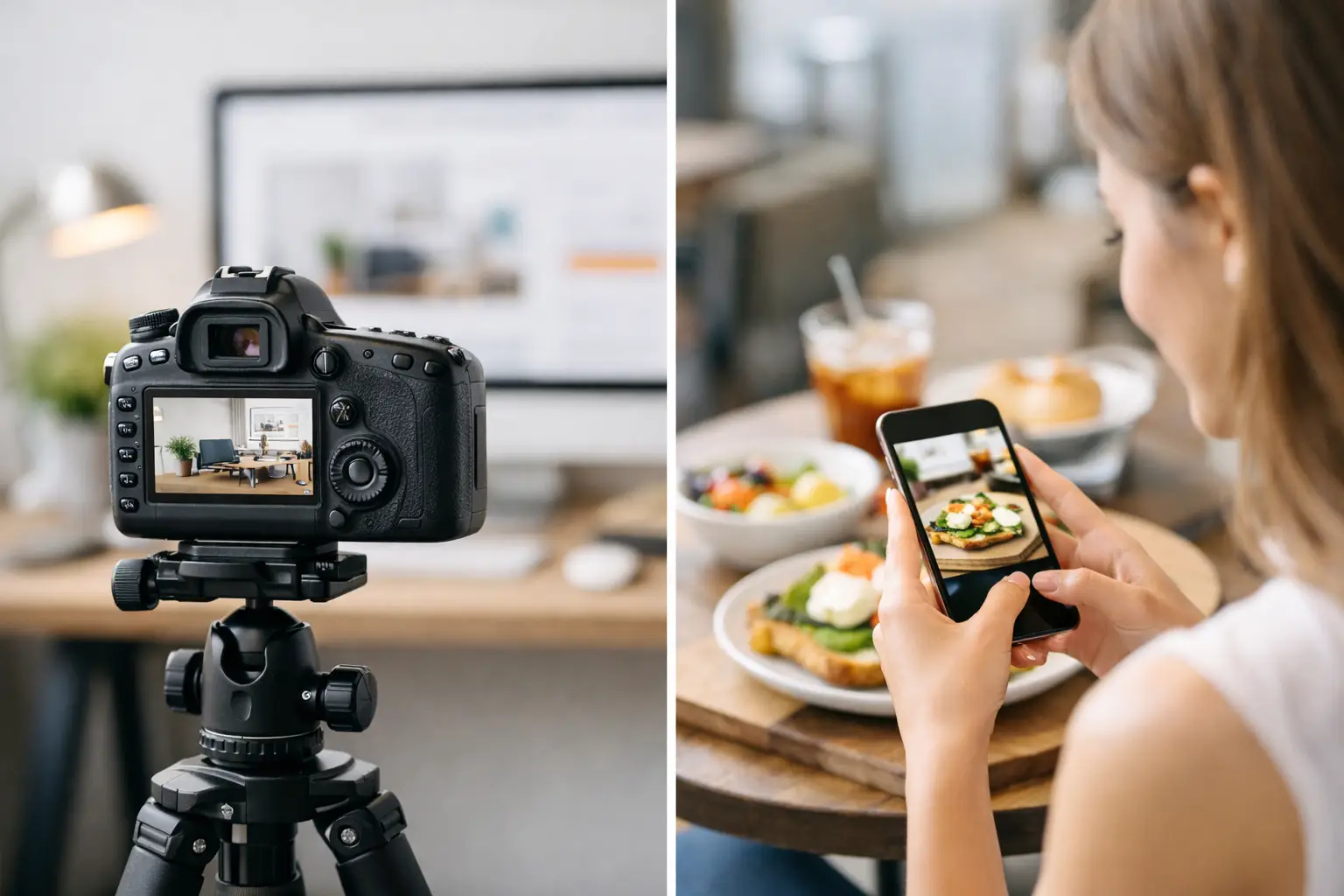
A prospective customer lands on your homepage, then checks your Instagram profile before making contact. In those few moments, they are not simply looking at photographs. They are deciding whether your business feels credible, current, capable, and worth their attention. Website photography vs social media photography is not a choice between two styles of content. It is a question of how one visual system can serve two very different customer experiences.
For brands that invest in professional imagery, the strongest answer is rarely to choose one channel over the other. It is to understand what each channel asks an image to accomplish, then plan a photography library that gives both the website and social channels the right material.
Website Photography vs Social Media Photography: Different Jobs
Your website is where visual confidence has room to build. Visitors can look more closely at a project, meet your team, understand your process, compare services, and see the physical environment behind the brand. Photography on a website needs to support clarity as much as it supports visual appeal. It should make the business easier to understand.
Social media works under different conditions. A viewer may give a post a second before scrolling past it. The image needs an immediate point of interest, a clear subject, and enough energy to earn attention in a crowded feed. It can be more candid, timely, playful, or tightly focused than the image that anchors a website banner.
Neither purpose is more valuable. Website photography helps reduce hesitation when customers are evaluating a business. Social photography creates repeated moments of recognition and gives people reasons to engage before they are ready to buy. One builds depth; the other creates momentum.
Website Images Carry the Weight of Trust
A website is often the closest thing a customer has to an in-person visit. For a professional services firm, that may mean confident environmental portraits and real images of a team at work. For a manufacturer, it can mean a well-composed view of the facility, equipment, safety practices, and skilled people behind the operation. For a restaurant, it means food, atmosphere, and hospitality working together to create a sense of place.
The best website photography answers questions without making visitors search for the answers. What does this company do? Who do they serve? What does the work look like? Are the people experienced? Is this a business I can trust with a meaningful purchase or partnership?
Composition tends to be more deliberate and spacious for the web. A horizontal image may need room for headline copy, navigation, or a call to action. A service page may need a sequence of photographs that moves naturally from broad context to useful detail. Brand consistency matters because visitors often view several pages in one session. If the imagery shifts wildly in color, lighting, or tone, the brand can feel less considered than it actually is.
Social Images Need an Immediate Reason to Stop
Social media favors images with a quick read. A chef finishing a dish, an engineer inspecting a component, a founder sharing a candid moment with a client, or a close product detail can all create a strong pause in the feed. The subject should be clear even on a small screen.
That does not mean every social post needs to be loud or overly polished. In fact, a constant stream of highly staged images can feel distant. Social channels give brands an opportunity to show process, personality, scale, and small human moments that may not belong in a permanent website hero section.
The format also changes the creative decision. Vertical images often make better use of mobile screens. Square crops remain useful for profile grids and certain campaigns. Short sequences of related photos can turn one shoot into a story, showing preparation, action, and outcome. A single photograph may be excellent, but social content often performs best when it is part of a larger rhythm rather than an isolated post.
One Brand Story, Not One Crop
A common mistake is assuming that a website image can simply be resized for social media. Sometimes it can. Often, the crop removes the part of the photograph that made it useful.
Consider an environmental portrait designed for a website. It may include negative space on one side for a headline and show the subject within a workplace that reinforces their role. Crop that image vertically for a social post, and the workspace may disappear. The portrait becomes tighter, but the story becomes weaker. The reverse can happen as well: a compelling vertical close-up for social may not offer enough context or width to work as a website banner.
The solution is not to create separate, disconnected photo shoots for every channel. It is to build variation into the shot plan. During a commercial photography session, the creative team can capture horizontal, vertical, wide, medium, and detail-focused frames around the same core scenes. This preserves the visual identity while giving marketing teams practical options.
A well-planned brand library should include images that establish context, reveal process, showcase people, and highlight the details customers care about. The exact mix depends on the business. An industrial company may need more operational and environmental coverage. A hospitality brand may need a deeper range of food, interiors, staff interactions, and seasonal moments. A consulting firm may place greater emphasis on authentic team portraits and client-facing environments.
Plan the Shoot Around Real Marketing Use
The most efficient photography projects start before the camera comes out. Marketing teams should identify where the images will appear and what each placement needs to communicate. This avoids a gallery filled with attractive photographs that have no clear role once the shoot is complete.
Start with the website pages that matter most. A homepage may need a broad, confident lead image. Service pages may require specific scenes that demonstrate expertise. An about page needs photographs that make leadership and culture feel real. Case studies, recruiting pages, presentations, proposals, and media materials may have their own needs as well.
Then look at the social calendar. Are you planning to feature employees, spotlight projects, introduce products, mark seasonal campaigns, or show behind-the-scenes work? These themes will influence what should be photographed. A social plan does not need to dictate every frame, but it gives the production team useful direction.
It also helps to define what should not appear. Outdated uniforms, old signage, unfinished spaces, sensitive information on screens, or temporary materials can limit how long images remain usable. Commercial photography has a longer shelf life when these details are managed in advance.
Leave Room for Content and Change
Website photography often benefits from intentional negative space. Designers need places for headlines, buttons, and text overlays without covering a face or a key product feature. This is a strategic detail that can make an image far more useful across page layouts and campaign variations.
Social photography benefits from flexibility of another kind. It needs fresh combinations of subjects, angles, and moments so a channel does not feel repetitive. Capturing several expressions, interactions, and details in one setting gives a social manager more material to work with over time.
This is where collaboration is the key to creativity. When photographers, marketers, designers, and operational leaders share the same objectives, the result is not just a collection of images. It is an organized visual resource that can support the business for months or years.
Quality Means More Than Resolution
Technical quality matters on both channels, but it is not the entire standard. A sharp, properly lit image can still fail if it feels generic or does not reflect the brand. Stock-like scenes, forced smiles, and disconnected visual styles can undermine the credibility a company is trying to build.
The more valuable question is whether the photograph feels specific to your organization. Does it show the real character of your people, products, work, and environment? Does the color treatment suit the brand? Does the image communicate the level of care customers can expect?
Social platforms compress files, display images at changing sizes, and favor mobile viewing. Website platforms need images optimized for load speed without making them look soft or lifeless. A professional production and post-production process accounts for both. The goal is to retain visual impact while making the assets practical for the channels where they will live.
When to Prioritize One Channel First
There are situations where one channel should lead the investment. A company launching a new website, entering a new market, or rebuilding its sales materials should prioritize foundational website photography. Clear, polished visuals can reshape how the entire business is perceived.
A brand with a strong website but an inconsistent social presence may need a more content-focused refresh. In that case, the shoot can place extra emphasis on vertical compositions, recurring content themes, and the people or details that make frequent publishing possible.
Still, the best projects avoid treating these as competing priorities. A thoughtful production can create hero imagery for the website and a broad set of social-ready assets from the same visual direction. Image Calgary approaches commercial photography as a collaborative brand-building process, because understanding the brand story is the first step to creating imagery with lasting value.
Before your next shoot, ask a simple question: what should a customer believe after seeing these images? When that answer is clear, your website and social channels can each tell the right part of the story – and together, they can make your business far easier to remember.