
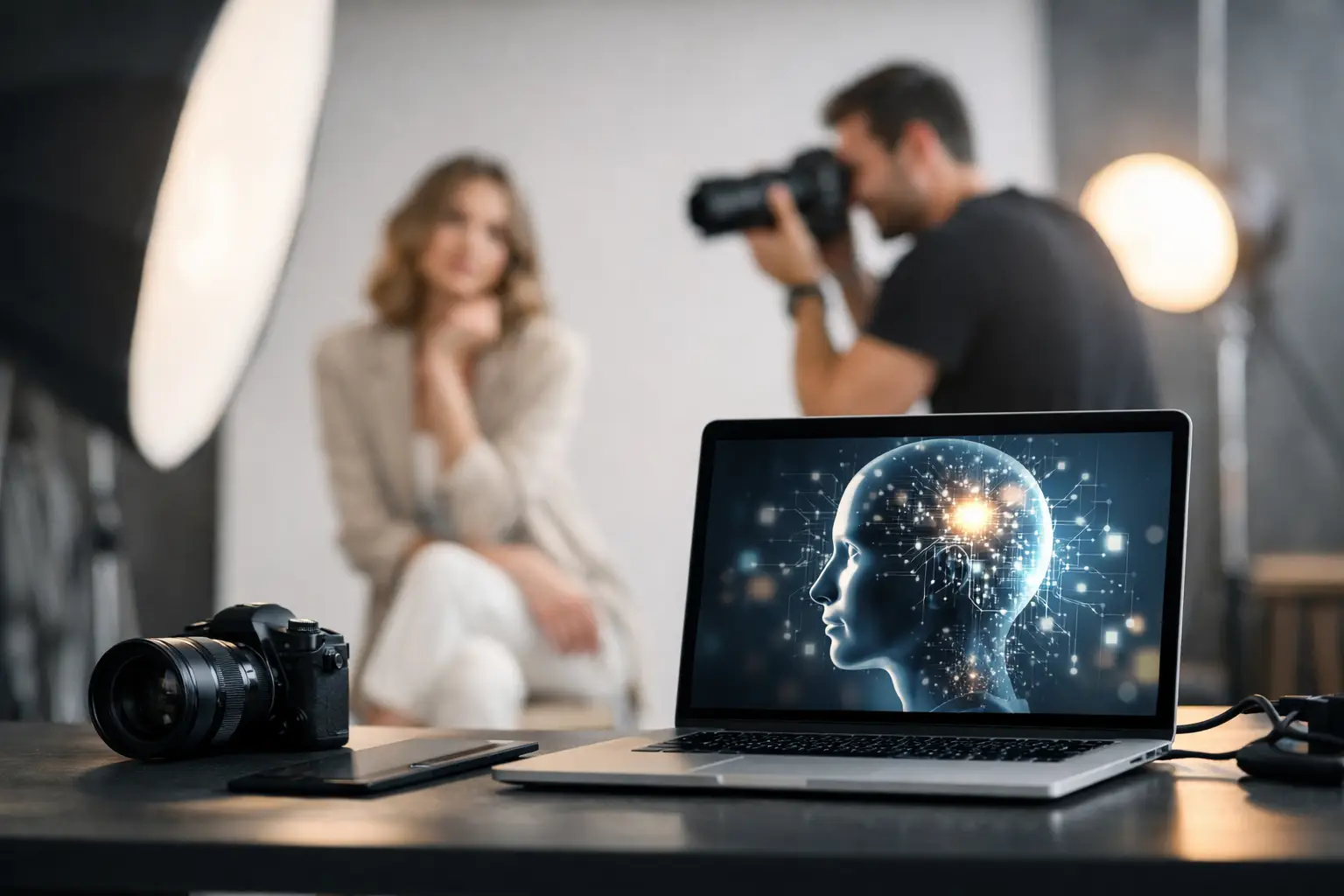
A polished product image can now be generated in seconds. A convincing office scene can be built without a location, crew, or camera. That speed is why the AI impact on commercial photography has become a serious business conversation, not just a creative trend.
For marketing teams, the appeal is obvious: lower production costs, faster concepting, and a nearly unlimited supply of visual variations. But commercial photography is not simply the act of making an attractive image. It is the work of showing what a brand actually stands for, how its people operate, and why customers should believe it.
AI is changing the production process. It is not removing the need for thoughtful visual strategy, professional direction, or real-world credibility.
Where AI is changing commercial photography
AI is already useful in many parts of a commercial photography workflow. It can help develop mood boards, visualize campaign ideas, remove distractions from backgrounds, extend image crops for specific ad formats, and accelerate routine post-production. Used with discipline, these tools can give a team more time to focus on the creative decisions that matter most.
For a restaurant, AI-assisted retouching may help refine a distracting reflection on a glass or adjust a composition for a social campaign. For an industrial business, it may help a creative team pre-visualize a complex shoot before stepping onto an active site. For an agency producing multiple versions of a campaign, it can support fast layout testing and early-stage art direction.
Those are meaningful efficiencies. They can reduce wasted effort and make production more responsive, particularly when a campaign needs a large range of deliverables across web, print, social media, and presentations.
The difference is in how the technology is used. AI works best as a production assistant and concepting tool, not as a substitute for the brand judgment behind an image.
Speed does not equal strategic clarity
A generated visual can look polished while saying very little. Many AI images lean toward a familiar commercial style: perfect lighting, idealized people, pristine spaces, and surfaces without a trace of real use. That can work for an abstract illustration or an early creative mockup. It becomes less effective when a business needs to earn confidence from customers, investors, recruits, or partners.
A professional services firm is not only selling a boardroom. It is communicating expertise, approachability, and the character of its team. A manufacturer is not only showing equipment. It is demonstrating capability, safety, process, scale, and pride in the work. Those details are difficult to invent convincingly because they come from observation, not prediction.
The strongest commercial images begin with questions: Who needs to see this? What should they understand immediately? What should they feel? What makes this company distinct from the next option on the market? AI can support the answers, but it cannot reliably define them.
The AI impact on commercial photography depends on the assignment
Not every visual need requires the same level of authenticity. A conceptual social graphic, a speculative campaign treatment, or a background image for an internal presentation may be appropriate places to use generated imagery. The stakes are lower, and the image can be judged primarily on whether it communicates an idea.
The equation changes when the subject is the business itself.
If an image shows your team, facility, product, food, service environment, or customer experience, real photography carries a different kind of value. It gives audiences evidence. It shows that the people and places behind the brand exist, that the product has material qualities, and that the work is being done by professionals rather than assembled from visual clichés.
This matters in industries where trust is central. Corporate communications, healthcare, construction, energy, hospitality, food and drink, professional services, and industrial operations all depend on signals of competence and accountability. A glossy but fabricated image can create distance at the very moment a company needs to feel more credible.
There are also practical risks. AI-generated visuals can introduce inaccurate details, inconsistent products, improbable architecture, awkward hands, unsafe work practices, or imagery that resembles an existing artist’s or brand’s style too closely. Even when an image looks plausible at first glance, a knowledgeable customer or employee may spot what is wrong.
That does not mean every photograph must remain untouched. Commercial photography has always involved lighting, styling, retouching, compositing, and careful editing. The standard is not whether an image is completely unaltered. The standard is whether it truthfully supports the promise a brand is making.
Authenticity is now a competitive advantage
As generated content becomes more common, real images become easier to recognize for the right reasons. They contain the details that generic visuals often miss: the rhythm of a working team, the specific texture of a product, the personality of a chef, the lived-in character of a workspace, and the small moments that make a company believable.
Authenticity is not the same as casual or unpolished. A strong commercial photographer shapes real moments through creative direction, lighting, composition, styling, and a clear understanding of how the final images will be used. The result can be highly refined while remaining grounded in reality.
That balance is especially valuable for businesses that have relied on stock photography or outdated internal images. A custom image library creates consistency across the website, sales materials, recruitment campaigns, editorial features, and advertising. It gives the brand an ownable visual point of view rather than a collection of images that could belong to anyone.
For Image Calgary, collaboration is the key to creativity. Understanding a client’s brand story before production makes it possible to photograph more than a subject. It allows the final work to communicate the energy of a team, the scale of an operation, the quality of a product, or the experience behind a service.
A smarter model: AI-supported, photographer-led
The most useful future is not a choice between AI and photography. It is a photographer-led process that uses AI where it adds genuine value and keeps people accountable for the decisions that shape brand perception.
AI can strengthen pre-production by helping teams explore visual directions quickly. It can assist with shot planning, background cleanup, asset resizing, and versioning after the shoot. It may also help identify gaps in a content library, allowing a marketing team to plan more effectively for a full year of campaigns.
The photographer, creative director, and client still need to lead the essential work: defining the message, selecting the visual language, directing people, managing locations, handling product and food styling, recognizing the moments worth capturing, and protecting brand consistency. These are not minor details. They are the difference between a usable image and an image that moves a business forward.
For commercial clients, the right question is not, “Can AI make this image?” It is, “What does this image need to accomplish?” If the goal is to test a creative route or communicate a broad idea quickly, AI may be a sensible option. If the goal is to show who you are and build long-term trust, a planned photography production is usually the stronger investment.
What businesses should protect in an AI-enabled workflow
Before approving AI-generated or AI-altered imagery, marketing teams should set clear standards around accuracy, usage rights, brand representation, and disclosure where appropriate. A visual should never imply a service, facility, product feature, employee, or customer experience that does not exist.
It is also worth protecting visual consistency. Brands can lose clarity when each department creates imagery independently with different prompts, styles, and quality levels. A defined art direction, an approved image library, and a trusted creative partner keep the work cohesive across channels.
Most of all, protect the human story. Customers do business with companies they understand and believe. Employees want to see themselves reflected in the brand. Prospective clients want proof that a company can deliver what it promises. Photography remains one of the clearest ways to provide that proof.
The tools will continue to change, and commercial photography will continue to evolve with them. The businesses that stand out will be the ones that use new technology with intention while keeping their real people, real work, and real point of view in focus.