
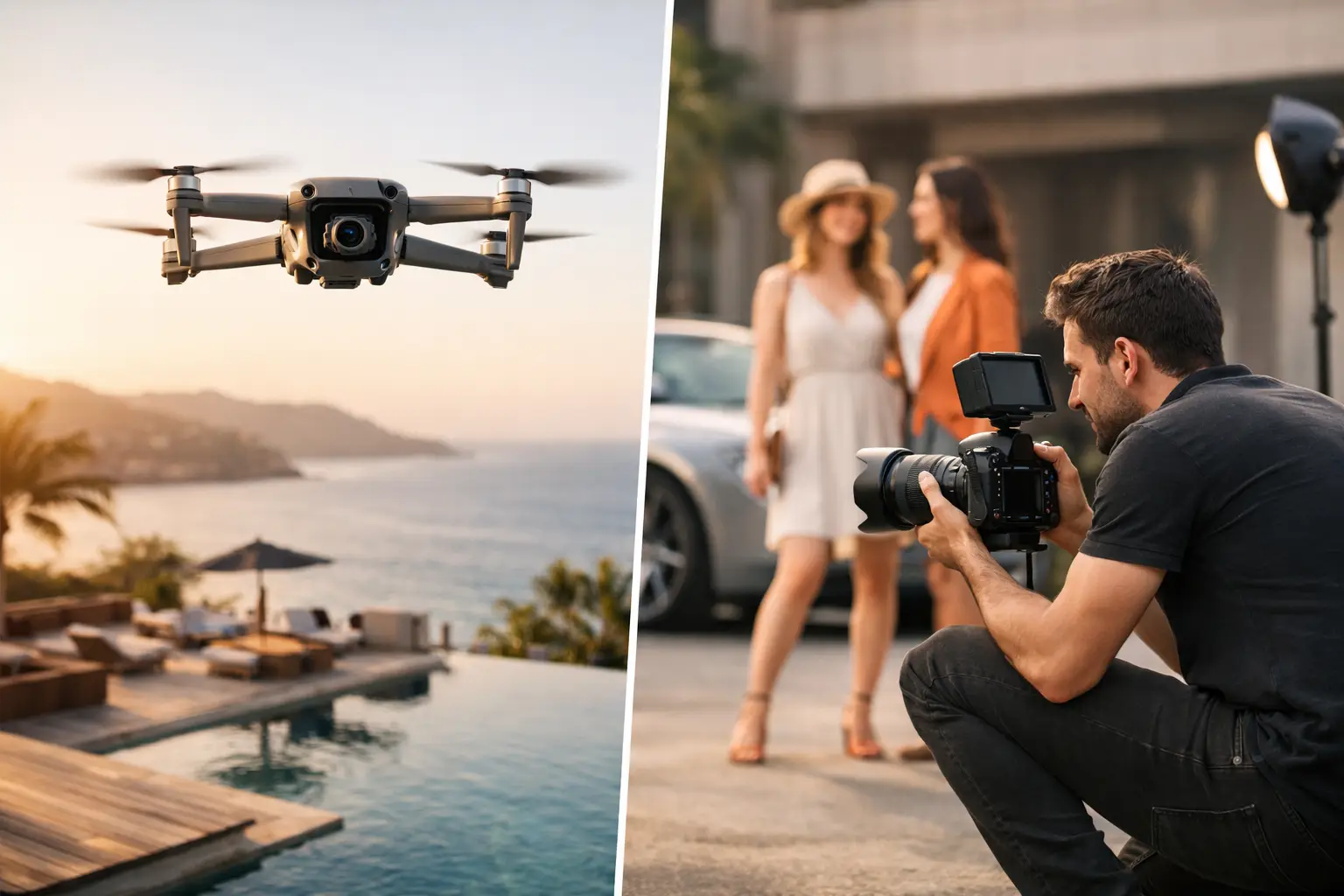
A refinery at sunrise, a hotel set against the foothills, a packed restaurant patio, or a construction site moving at full pace all present the same creative decision: what perspective will make the story clear? Drone versus ground photography is not a choice between a modern option and a traditional one. It is a strategic decision about how your audience should see your business.
For commercial brands, the strongest visual campaigns rarely depend on one viewpoint alone. Aerial imagery establishes context and scale. Ground photography creates connection, detail, and credibility. Knowing when each serves the message helps turn a photo shoot into a collection of useful brand assets rather than a set of attractive but disconnected images.
Drone Versus Ground Photography: What Each Perspective Says
A drone camera changes the relationship between the viewer and the subject. From above, a property becomes part of its neighborhood, a worksite reveals its scope, and a logistics operation shows the organized movement that cannot be understood from eye level. Aerial photography gives a brand visual authority because it provides the larger picture.
Ground photography brings the audience into the experience. It can show the craft behind a plated meal, the concentration of a field technician, the materials and finish of a product, or the welcome a customer receives at the door. It is where personality lives. For organizations that want to communicate trust, culture, quality, or care, these close human moments often do the heaviest lifting.
Neither approach is automatically more compelling. A striking overhead view may earn attention, but it cannot replace a well-observed image of your people at work. Conversely, a polished environmental portrait can feel isolated if the audience never understands the scale or setting of the operation. The question is not which image looks more impressive. It is which perspective gives the audience the information and feeling they need.
When Aerial Photography Has the Advantage
Drone photography is especially effective when location is part of the value proposition. Commercial real estate, hospitality, tourism, land development, construction, agriculture, energy, and industrial businesses can all benefit from images that show access, terrain, surrounding amenities, site scale, or operational complexity.
For a developer, an aerial image can communicate proximity to major routes, green space, transit, and neighboring businesses in a single frame. For a manufacturer, it can show the footprint of a facility and the activity that supports production. For a resort or venue, it can establish the setting before the viewer sees the individual spaces within it.
Aerial footage and stills also add energy to campaigns built for websites, social channels, presentations, and editorial use. A high, angled view creates immediate visual separation from the familiar eye-level photography audiences see every day. Used with purpose, it gives a campaign a sense of ambition and momentum.
Still, altitude is not a substitute for strategy. A drone image that shows a large building without clear activity, strong light, or a meaningful surrounding context can feel distant. The best aerial work has a point of view. It directs attention to the feature that matters, whether that is a project’s location, the relationship between teams and equipment, or the shape of a destination.
Aerial photography has practical limits
Drone production requires more planning than simply launching a camera. Airspace restrictions, weather, wind, privacy considerations, site safety, and local permissions can all affect what is possible on a given day. In urban locations and near airports, these details are particularly important.
A commercial photographer should assess the location and flight requirements before the shoot, build appropriate time into the production schedule, and maintain a backup plan. Weather may soften the light beautifully for ground portraits while making a drone flight unsafe. A smart creative plan protects the project from these variables rather than treating them as an afterthought.
When Ground Photography Creates More Value
Ground photography is the essential choice when the viewer needs to feel present. It captures the gestures, materials, textures, interactions, and expressions that define a brand experience. This makes it especially valuable for professional services, hospitality, food and drink, retail, healthcare, corporate culture, product launches, and recruitment campaigns.
A restaurant may use aerial imagery to establish its building or patio, but customers decide where to dine based on the food, atmosphere, service, and details they can imagine themselves enjoying. A professional services firm may photograph its office exterior from above, yet its website needs confident portraits and genuine team interactions to make expertise feel approachable.
The same principle applies to industrial brands. A drone can show a large operation at work, while ground-level images show the people, processes, safety practices, machinery, and precision behind that operation. Those details matter to clients, recruits, partners, and investors. They make an organization’s capabilities tangible.
Ground production also offers more control. Lighting can be shaped, product placement can be refined, and people can be directed with care. That control is useful when imagery must align closely with established brand colors, campaign art direction, or a high-end visual standard. Aerial work can be carefully composed, but it is less suited to the intimate, exacting decisions that often define product and portrait photography.
Build the Shoot Around the Customer Journey
The most effective choice often comes from mapping photography to the way your audience encounters the brand. Start with the opening impression. What needs to stop a visitor on a homepage, a trade-show display, or a campaign ad? Aerial imagery may be ideal for that first moment if scale and location are central to the story.
Then consider what earns confidence. This is usually where ground photography takes over. Images of people, products, service, process, and customer experience answer the practical questions behind a purchasing decision. They show that the promise made by the headline is supported by real work and real standards.
Finally, think about the range of channels where the images will live. A wide drone view may work beautifully as a website banner, a print spread, or an opening presentation slide. Vertical ground portraits may be more useful for social posts, recruitment materials, case studies, and team profiles. Planning for crop formats and usage early prevents a common problem: having one beautiful hero image and not enough supporting content for the rest of the campaign.
Use both perspectives for a complete brand story
For many commercial projects, a combined approach is the most efficient option. Photograph the exterior, surrounding environment, and broad operations from the air, then move to the ground for the visual evidence that brings the story to life. The result feels intentional because every image has a role.
Consider a new industrial facility. Drone photography can establish the site, its scale, and its relationship to transportation corridors. Ground photography can document equipment, quality control, employee expertise, leadership portraits, and safety-focused processes. Together, these images can support a launch announcement, sales presentation, recruitment campaign, annual report, and website refresh without repeating the same visual idea.
This is where collaboration is the key to creativity. Before cameras arrive, clarify the audiences, key messages, locations, must-have subjects, and intended deliverables. A photographer who understands the business purpose can recommend the right balance of aerial and ground coverage, rather than treating the drone as an add-on.
Choose Perspective Based on the Story, Not the Trend
Drone photography attracts attention because it is visually dramatic. Ground photography remains indispensable because it is where brands become relatable. Both can be polished, cinematic, and memorable, but they deliver different kinds of value.
If your message depends on scale, setting, access, or operational scope, start by considering the aerial perspective. If it depends on trust, craft, people, or the experience of working with your business, prioritize the ground-level view. If both are true, build a shot plan that lets each perspective do its job.
The right photograph does more than document what your organization looks like. It helps the right audience understand why your work matters, and gives them a reason to look closer.