
A great industrial image may show a welder at work, a crew member high above a production floor, or a complex piece of equipment in motion. What it should never show is a photographer, employee, or visitor taking an unnecessary risk for the camera. This industrial photography safety guide is designed for businesses that want compelling visual content without disrupting operations or compromising the standards that protect their people.
Industrial photography has a particular responsibility. The work often happens around active machinery, vehicles, elevated platforms, electrical systems, restricted areas, and time-sensitive production schedules. The strongest images feel immediate and authentic because they document real work. That authenticity only works when the shoot is planned around the site, the crew, and the safety culture already in place.
Safety Starts Before the Photographer Arrives
The most effective safety decisions happen during pre-production, not on the production floor. A productive planning conversation should include the photographer, the client project lead, a site supervisor, and, where appropriate, the safety representative. This is the point to clarify what needs to be photographed, which areas are available, what processes will be active, and what restrictions apply.
A shot list is useful, but it should not be treated as a fixed creative mandate. If a planned image requires a person to enter a restricted zone, remove protective equipment, stand too close to a process, or interrupt a critical workflow, the image needs to change. There is almost always a safer way to tell the same story through angle, lens choice, timing, or a different location.
Before the shoot, provide the photographer with relevant site requirements. These may include visitor orientation, hazard assessments, permits, confidentiality expectations, emergency procedures, required personal protective equipment, and rules for aerial or drone work. A photographer who understands the environment can work more efficiently and make stronger visual decisions from the start.
Define Who Has Authority on Site
One person should be designated as the site contact for the shoot. That individual can coordinate access, identify safe areas, confirm when equipment can be photographed, and stop the session if conditions change. This protects everyone from mixed instructions, particularly at larger sites where different departments have different priorities.
The site contact should have the authority to say no. A polished industrial campaign is valuable, but no marketing objective outweighs an active hazard, a maintenance procedure, or an operator’s need to focus. Clear authority keeps safety decisions quick and respectful.
Personal Protective Equipment Must Be Real
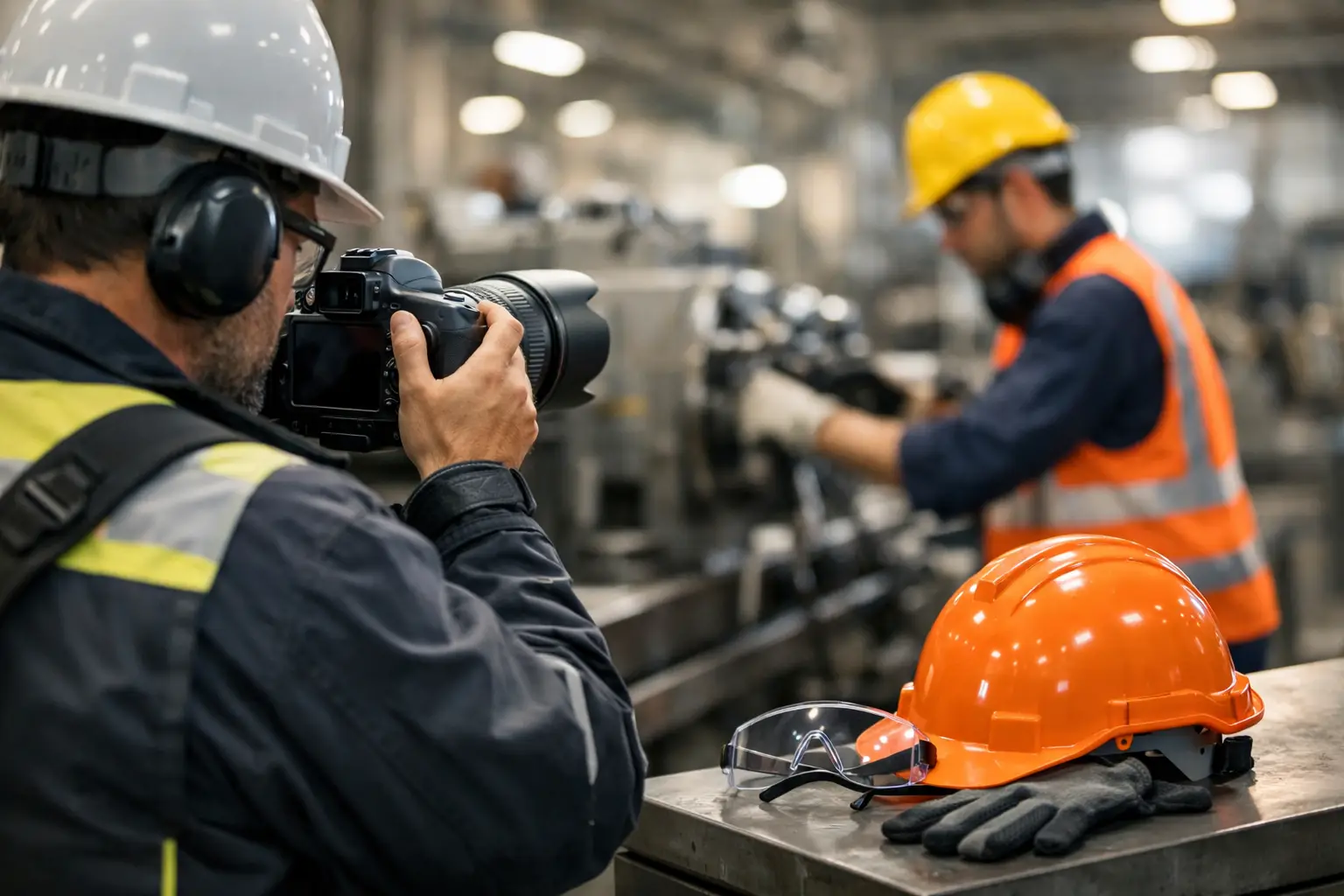
PPE is one of the most visible elements in industrial photography, and it is often where otherwise credible images lose trust. If employees are required to wear hard hats, safety eyewear, hearing protection, gloves, high-visibility garments, or specialized protective clothing in a given area, they should wear it in the photograph.
Do not ask people to remove PPE because it hides their face or conflicts with a preferred wardrobe color. Those requests can undermine both the safety message and the brand. Instead, build the composition around the equipment. A clear profile, a moment of collaboration, hands at work, or a wide environmental portrait can communicate confidence and human connection while respecting the conditions of the site.
There are exceptions. A portrait captured in an office, break room, or designated safe area may not require the same gear. The key is context. Viewers should be able to see that the image reflects a real setting and a responsible decision, not a staged shortcut.
Build the Industrial Photography Safety Guide Around the Work
The safest shoot is one that works with operations rather than attempting to control them. Production teams should not have to alter safe routines, rush a task, or repeat a hazardous action simply because a camera is present. Photography needs to adapt to the workflow.
This can mean scheduling around shift changes, planned maintenance windows, lower-traffic periods, or moments when a process is already visible from a safe observation point. It may also mean using a longer lens instead of moving closer, photographing through approved barriers, or capturing activity from an elevated but authorized position.
Lighting deserves special consideration. Additional lighting can improve clarity and add visual depth, but light stands, cables, batteries, and modifiers can become trip hazards or obstructions. In some environments, certain equipment may be prohibited entirely. A skilled commercial photographer evaluates available light first, then adds only what the location and safety team permit.
Respect Equipment, Vehicles, and Active Processes
Industrial sites are not studios with dramatic backdrops. Forklifts, cranes, conveyors, loading bays, rail lines, and heavy equipment operate according to procedures that cannot pause for a photo angle. Photographers and assistants should never step into traffic routes, cross barriers, climb on machinery, or place equipment where it affects visibility or access.
Operators should also remain focused on their work. If a person must look toward the camera, pause a task, or reposition for a portrait, make that request only after the supervisor confirms it is appropriate. Often, the best frames come from observing a process as it happens rather than directing it.
When photographing specialized equipment, confirm what can be shown. Some facilities restrict images of control panels, proprietary systems, security infrastructure, or client materials. These limitations do not weaken the creative outcome. They simply direct attention toward the people, scale, precision, and problem-solving that define the operation.
Plan for Changing Conditions
Industrial sites change quickly. A pathway that was clear in the morning may be closed after lunch. Weather can affect outdoor locations, vehicle activity can increase, and a maintenance issue can limit access without warning. A flexible production plan is a practical safety measure.
Build alternate images into the schedule. If the primary location becomes unavailable, the team can shift to a secondary department, detail shots, environmental portraits, or approved exterior views. This prevents the pressure to force a shot in conditions that are no longer suitable.
Weather requires particular care in Western industrial environments. Wind, ice, extreme cold, heat, dust, rain, and uneven terrain affect both people and equipment. Aerial photography may need to be postponed due to wind, airspace restrictions, or changing site activity. The right call may be to reschedule. Strong visual production is not measured by whether every idea happens on one day.
Make Safety Visible in the Final Image Selection
Safety is not only a production concern. It is also an editing and selection standard. Before images are delivered or published, review them with a knowledgeable client contact. Look beyond exposure, composition, and brand fit. Check whether PPE is worn correctly, barriers are respected, machinery appears properly operated, and no one seems to be in a position that contradicts site policy.
This review matters because photographs become public evidence of how a company operates. A single image of an employee without required eyewear, a vehicle in an unsafe position, or a blocked emergency route can raise questions with customers, recruits, regulators, and the team itself. The image may have been taken in a controlled moment, but audiences will judge what they see.
At the same time, do not overcorrect until the images feel sterile. Industrial photography should retain energy, scale, and human purpose. The goal is not to make a facility look empty or overly managed. It is to show capable people doing meaningful work within a culture that takes care seriously.
The Creative Advantage of a Safety-First Shoot
Safety and creativity are not competing goals. Clear boundaries often lead to more considered photography. They encourage better observation, stronger composition, and images that feel grounded in the reality of the business rather than borrowed from a generic stock library.
When teams are briefed, supervisors are involved, and the photographer understands the site, people tend to relax. The resulting images show genuine concentration, pride, collaboration, and technical skill. They can support recruitment, corporate communications, proposals, websites, annual reports, and marketing campaigns while representing the organization with accuracy.
The best industrial photography does more than document the work. It demonstrates the standards behind it. Give the production team enough information to plan well, give site leaders permission to protect the operation, and let the images reflect the confidence that comes from doing both.