
A strong workplace image can lose its credibility in one frozen second: a capable employee stands beside the equipment they use every day, smiling at the camera with no real connection to the moment. Learning how to direct nonmodels naturally changes that. It helps a brand show real people with confidence, warmth, and the kind of believable energy customers recognize.
For commercial photography, authenticity is not an accident. It comes from thoughtful planning, a calm set, and direction that gives people something meaningful to do rather than asking them to perform. The goal is not to turn employees into actors. It is to create conditions where their expertise, personality, and connection to the work can come through.
Start with a role, not a pose
Nonmodels are often most uncomfortable when they are told to “look natural.” The instruction is vague, and most people respond by becoming more aware of their hands, face, and posture. Instead, give them a clear role in a believable scene.
An engineer can review a plan with a colleague. A chef can make a final adjustment to a plate. A consultant can walk a client through a detail on screen. These are not invented performances. They are simplified, visually organized versions of actions that already happen in the business.
Before the shoot, identify the real moments that communicate the brand story. For a construction company, that may be a site conversation, a safety check, or a close look at materials. For a hospitality business, it may be the welcome at the door, the preparation behind the bar, or a server delivering a finished dish. When the activity is familiar, people have less mental space to worry about the camera.
The action should also be specific enough to photograph well. “Talk about the project” is less useful than “stand beside the drawing, point to this area, and tell your colleague what changes next.” Direction becomes easier when everyone understands the purpose of the scene.
Build trust before the camera comes up
The best direction begins before the first frame. A commercial shoot can feel high stakes for employees, particularly when the images will appear on a website, in a campaign, or in company communications. Let people know why they were selected, how the photos will be used, and what will happen during their time on set.
A brief introduction matters. Explain that they do not need to know how to pose and that the photographer will guide them through each setup. This is not empty reassurance. It sets the expectation that the responsibility for the image sits with the creative team, not with the person in front of the lens.
Small practical details also protect confidence. Schedule people in manageable groups, allow time for them to return to work, and make sure wardrobes, workspaces, and props are ready before they arrive. A person who has been waiting around while a scene is assembled is more likely to feel self-conscious once photography starts.
For leadership portraits or team imagery, it helps to discuss the desired feeling in straightforward language. Is the brand polished and formal? Approachable and service-led? Technical, energetic, inventive? People make better choices when they understand the tone, but avoid overloading them with brand terminology. Translate the visual goal into an immediate instruction: relaxed shoulders, a steady stance, conversation with a colleague, or a moment of focused work.
How to direct nonmodels naturally during the shoot
Keep direction short, positive, and active. Long explanations can make a nonmodel feel corrected or scrutinized. Give one adjustment at a time, then let the person settle into it.
Rather than saying, “Your expression looks stiff,” try, “Turn slightly toward Jordan, take a breath, and continue that conversation.” Rather than, “Do something with your hands,” give the hands a job: hold the sample, move the cup, mark the plan, adjust the tool, or rest them naturally on the work surface.
The strongest prompts often create a response instead of demanding an expression. Useful prompts include:
- Ask a colleague to share a quick story from a recent project.
- Have the subject explain a process they know well.
- Ask them to look at a detail, then look up to acknowledge the person beside them.
- Create a small movement, such as walking into frame or handing over an item.
These prompts work because they give the face a reason to change. A genuine listening expression, a brief smile, or a moment of concentration is far more convincing than a held grin.
Movement is especially valuable. Still poses can be effective for executive portraits or precise product-adjacent compositions, but movement gives nonmodels something to focus on besides the camera. Ask for a slow walk, then photograph several passes. Have two employees enter a meeting room, pause over a document, or reset a task. The first attempt may feel rehearsed. By the third or fourth, the rhythm often becomes more relaxed.
That said, movement must serve the image. Repeating a task without purpose can look staged, especially in industrial and technical environments. If the business values precision, show a real check, real collaboration, and correct safety practices. Authenticity includes accuracy.
Give people a focal point beyond the lens
Eye contact with the camera has a place, particularly in portraits meant to establish trust and leadership. But it should be intentional. In most lifestyle and workplace scenes, people look more comfortable when their attention is directed toward a colleague, a task, a product, or a point just off camera.
Set the eyeline before the subject enters the frame. Tell them exactly where to look and why. “Look at the report while she explains the numbers” is clearer than “look down a bit.” If they are interacting with another person, position both people so the connection reads in the image while their faces remain visible to the camera.
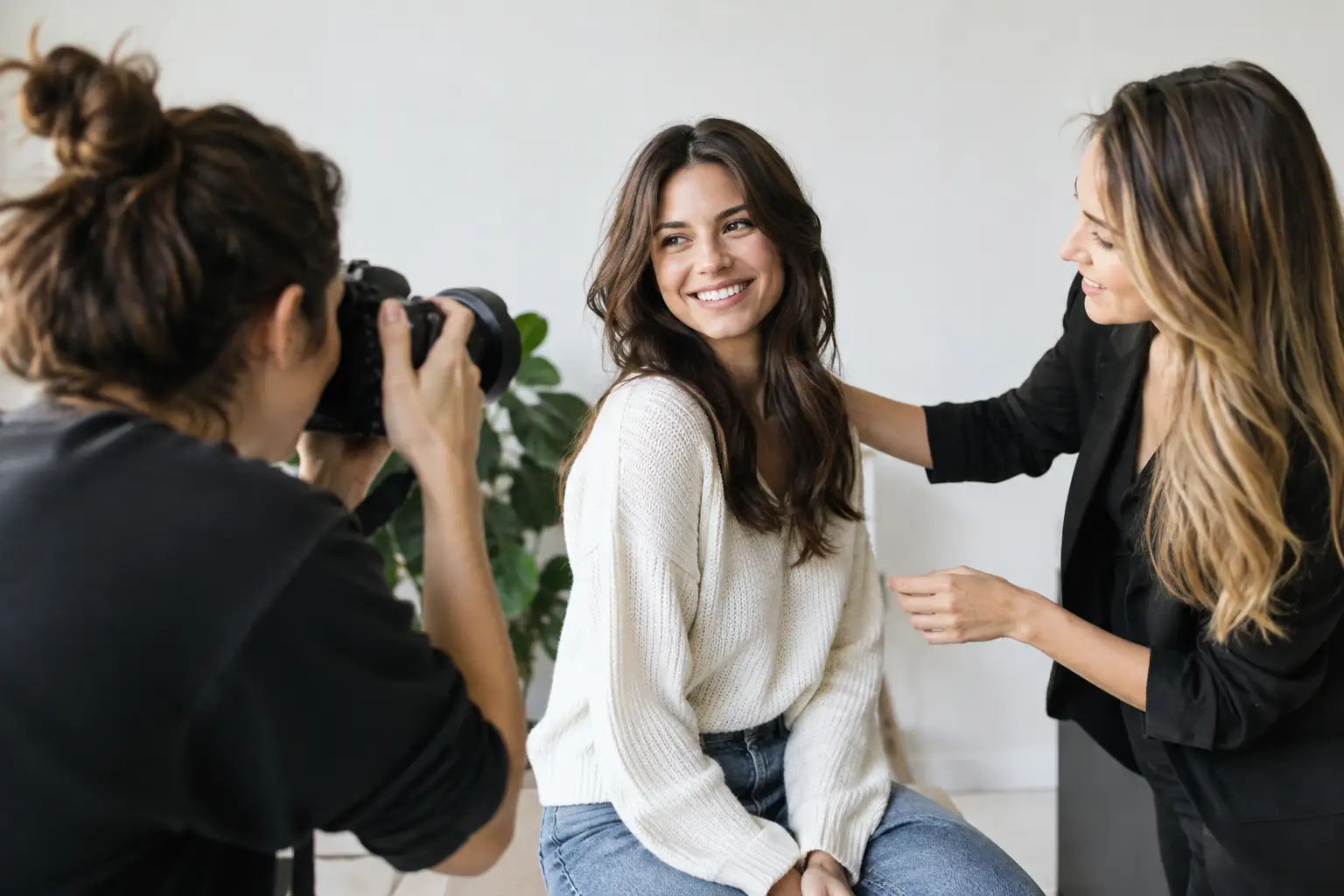
A photographer may need to make subtle adjustments for light and composition: move a shoulder, turn the chin, shift a foot, or ask someone to take half a step toward a window. Frame these changes as collaboration. “That looks great. Bring your left shoulder toward me slightly so we can catch the light in your face.” Specific praise followed by a clear next step keeps momentum moving.
Use pairs and small groups with care
Many people relax faster with a colleague nearby. Pairing employees can create natural interaction, distribute attention, and make a scene feel less like a portrait session. It is often an effective approach for company culture, professional services, hospitality, and industrial photography.
However, group scenes introduce their own challenges. One person may dominate the interaction while another disappears, or the group may form a tight cluster that hides faces and brand details. Build the scene around a simple relationship: one person demonstrates, one responds; one presents, one reviews; one prepares, one receives.
Give each person a reason to be there. If a person has no action or connection to the scene, their uncertainty will show. For larger teams, photograph smaller combinations first, then bring the group together once everyone has become comfortable with the process.
Know when to stop directing
Over-direction can drain the life out of an image. Once the posture, light, and interaction are working, step back and let the moment unfold for a few seconds. This is often where the most useful frames appear: the laugh after a prompt, the thoughtful pause, the quick exchange between coworkers.
Review images selectively when it will build confidence. Showing someone a strong frame can immediately change their body language. They see that they do not need to be a professional model to look capable and credible on camera. Avoid reviewing every image, though. Too much inspection can make subjects start judging themselves rather than staying present.
Commercial photography still requires direction, styling, and an eye for the details that represent a business well. Natural does not mean unplanned. It means the final image feels grounded in the people, place, and work it represents.
At Image Calgary, collaboration is the key to creating that kind of result. When people understand the purpose of the shoot and feel respected throughout it, the camera records more than a polished appearance. It captures the confidence behind the brand.