

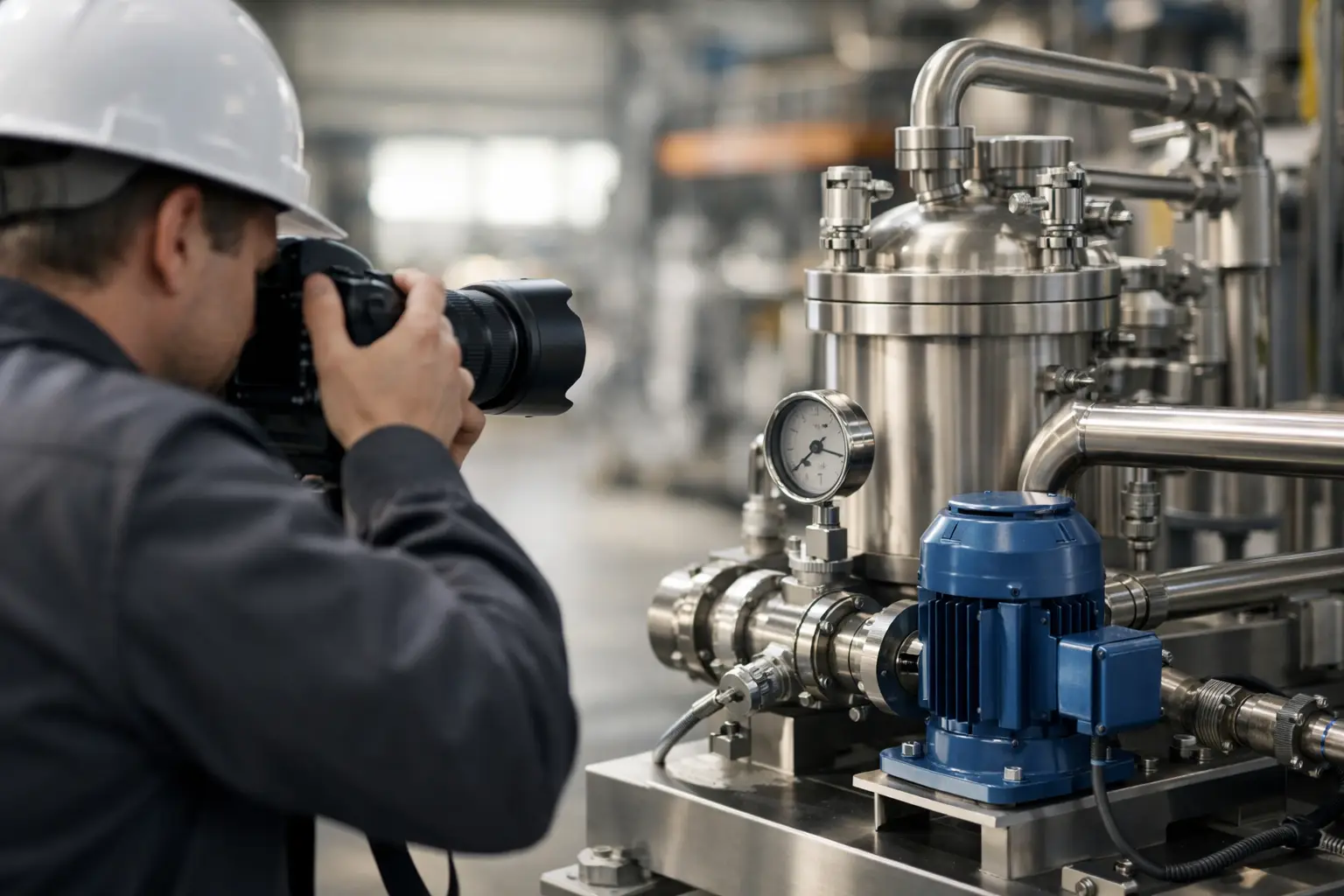
Industrial equipment rarely looks impressive by accident. A compressor, drilling rig, fabrication line, or fleet vehicle may represent years of engineering and serious investment, yet a poorly planned image can make it feel flat, cluttered, or indistinguishable from the competition. Knowing how to photograph industrial equipment means translating capability into a visual story that customers, investors, recruits, and partners can understand quickly.
For industrial businesses, the goal is not simply to document machinery. It is to show the scale, precision, expertise, and people behind the operation while protecting site safety and brand credibility. That requires a thoughtful production process before a camera ever reaches the floor.
Start with the business story, not the equipment list
A machine-by-machine shot list is useful, but it should not be the entire brief. Begin by identifying what the images need to accomplish. A manufacturer preparing a new website may need clean, versatile images that establish quality and process. An energy services company may need environmental portraits and wide operational scenes to support recruitment and corporate communications. A company launching a specialized product may need detailed photography that proves design features and craftsmanship.
Ask what makes the operation different. It could be advanced automation, a highly trained team, exceptional capacity, quality control, a demanding work environment, or a long-standing reputation for reliability. Those answers determine the visual priorities.
This is where collaboration changes the result. Marketing teams understand the audience and message. Site managers understand workflow, safety restrictions, and the moments worth seeing. A professional commercial photographer brings the ability to shape light, composition, and timing around both. When those perspectives meet before the shoot, the final library feels intentional rather than generic.
Plan access, safety, and timing before production
Industrial photography succeeds or fails on preparation. Active facilities are not studio sets, and a photographer should never interrupt production or create a safety risk for the sake of an image. A pre-shoot walkthrough helps identify access points, required personal protective equipment, confined or restricted areas, safety orientations, and site contacts.
It also reveals practical visual issues. Reflective metal surfaces, moving forklifts, overhead lighting, dust, steam, welding arcs, and tight spaces all affect how a shoot should be approached. Some locations require equipment to be cleaned or staged beforehand. Others are most photogenic during a specific shift, when the floor is active but not overcrowded.
Confirm whether employees can be photographed and whether branded uniforms, hard hats, screens, documents, or proprietary components need approval. If safety gear is required, every person visible in the frame must wear it correctly. An image with an unfastened helmet or missing eye protection can undermine a company’s safety culture in seconds.
A clear production plan should establish the essential scenes, the people needed for each one, and the time windows when equipment can be photographed without disrupting work. Build in flexibility. Manufacturing schedules change, weather affects exterior work, and the best moment may appear when a crew begins a task that cannot be repeated on demand.
Build images around scale and function
Industrial equipment often creates a challenge: without context, viewers may have no idea how large it is or what it does. Wide images establish the setting and scale. A worker positioned naturally near a machine can show its size while adding human energy to the frame. Elevated or aerial perspectives can reveal the footprint of a yard, facility, processing plant, or equipment fleet when the site and conditions allow it.
Then move closer. Medium views show how a person operates the equipment, where material enters or exits, and how multiple components work together. Detail images can focus on controls, textures, welds, gauges, precision tools, hydraulic connections, or a hand performing a skilled task.
Each view has a different job. Wide photographs give the audience context. Medium images explain process. Close-up images convey engineering, craft, and quality. A strong industrial photography library includes all three, allowing a marketing team to use the images across website banners, brochures, social posts, presentations, trade media, recruitment campaigns, and sales materials.
Use people to make the work credible
The most effective industrial photographs are often not just about the equipment. They are about the people trusted to operate, maintain, inspect, and improve it. A capable employee working with purpose gives the image a point of view and makes the operation feel real.
The key is authenticity. Avoid asking a technician to stare into the camera while holding a tool unless the brief specifically calls for a portrait. Instead, photograph actual tasks: inspecting a component, reviewing measurements, operating controls, coordinating a lift, loading material, or discussing a production issue with a colleague. Give people a simple action and enough room to perform it naturally.
Not every operation should be shown at full speed. Motion can communicate output and energy, but it can also produce visual chaos or unsafe positioning. In some cases, a controlled setup during a planned pause is the better choice. The image should look honest, while the process remains fully compliant with site rules.
Shape light instead of accepting the facility lighting
Many industrial spaces are lit for safe work, not for photography. Overhead fixtures can create uneven color, deep shadows, and bright reflections across metal and painted surfaces. The solution is not always to overpower the environment with artificial light. Often, the best photographs preserve the natural character of a working facility while carefully adding or controlling light where it matters.
Window light can bring dimension to a workspace. Directional supplemental lighting can reveal the form of equipment and separate a subject from a busy background. In tighter spaces, small lighting adjustments can make a major difference without obstructing a work area.
Reflections require special attention. Polished machinery may reflect the photographer, lights, clutter, or areas of the facility that do not support the brand. Camera angle, lens choice, equipment placement, and careful staging all help control what appears in those surfaces. This is one reason industrial photography benefits from experience: the final image may look effortless, but a great deal of problem-solving happens outside the frame.
Compose for clarity, not visual noise
Industrial sites are full of competing lines, signs, cables, pallets, pipes, and equipment. That visual density can be compelling, but it needs direction. Before taking a photograph, decide what the viewer should notice first. Is it the operator, the machine, the product, or the relationship between them?
Use leading lines, clean angles, and intentional framing to guide attention. Shift position to remove distracting background elements rather than assuming they can be fixed later. A few minutes spent clearing a stray box, unused ladder, or tangled cable can protect the professionalism of the image.
At the same time, do not over-sanitize the environment. An industrial company should look active and capable, not like a showroom with no evidence of real work. The right balance preserves the texture of the operation while removing distractions that dilute the message.
Capture a complete, flexible image library
A single hero image is valuable, but it cannot carry an entire brand presence. Plan for variety in orientation, composition, and use. Horizontal images are often useful for websites and presentations, while vertical images can work well for editorial layouts, recruitment materials, and social channels. Leave purposeful negative space in some frames for headlines or graphic treatments.
Include establishing exteriors, facility interiors, equipment in operation, product details, process moments, team interactions, and a small number of carefully directed portraits. If the business serves several markets, photograph the same equipment in ways that speak to different audiences. One image may emphasize technical precision; another may highlight capacity, service responsiveness, or the team’s expertise.
Think beyond the immediate campaign. A well-planned industrial shoot can create a durable content library, reducing the need to repeatedly arrange access, safety approvals, and production downtime. The images should feel consistent in color, energy, and visual quality so they can represent the company across every customer touchpoint.
Treat post-production as quality control
Editing should refine the image, not rewrite reality. Color correction, exposure balancing, minor cleanup, and careful cropping help create a polished, consistent set of photographs. Editing can also remove temporary visual distractions, provided it does not misrepresent the facility, equipment, safety conditions, or capabilities.
Maintain recognizable details such as accurate equipment colors, appropriate signage, and realistic working conditions. Industrial buyers are often technically knowledgeable. They notice when a process appears staged incorrectly or when an image makes an operation look unlike the real thing. Credibility is part of the creative standard.
The strongest industrial images make complex work easier to trust. They show that a company has the people, discipline, equipment, and standards to deliver. When the visual production is planned around that story, machinery becomes more than a collection of components – it becomes visible proof of what the business can do.