
A strong factory photograph does more than show machinery. It gives customers, recruits, investors, and partners a clear view of the capability behind your brand: skilled people at work, disciplined processes, quality control, and a facility built to deliver. Knowing how to prepare for a factory photo day is what turns that opportunity into a collection of useful, credible images rather than a rushed interruption to production.
Start With the Story You Need the Images to Tell
Before anyone cleans a workbench or adjusts a production schedule, define the business purpose of the photography. A manufacturer preparing images for a new website will need a different visual mix than a company supporting a recruitment campaign, investor presentation, annual report, or trade publication. The best photo day begins with a clear understanding of where the images will appear and who needs to believe in what they see.
Bring your marketing, operations, safety, and leadership teams into the conversation early. Together, identify the strengths that make your organization distinct. That may be advanced equipment, exceptional craftsmanship, a complex assembly process, a highly experienced team, rigorous testing, local production, or an unusually clean and efficient operation. These details shape the shot plan and help the photographer build images around your brand story instead of collecting generic factory scenes.
A practical brief should establish the desired audience, key messages, visual style, required formats, and any non-negotiable subjects. It should also flag sensitive areas, confidential processes, unreleased products, client information, and restricted equipment. A photo that looks impressive but exposes proprietary information is not a commercial asset.
Build a Factory Photo Day Shot Plan
A shot list is not a creative limitation. It is the framework that keeps a busy day focused on the images with the greatest commercial value. Prioritize the must-have photographs first, then leave room for the moments a photographer may recognize on the floor: a precise hand movement, welding sparks, a finished product moving through inspection, or a team interaction that reveals real pride in the work.
Most industrial photo days benefit from a mix of these image categories:
- Exterior and interior facility views that establish scale, location, and working environment.
- Hero images of key production lines, machinery, and finished products.
- People-focused images showing operators, technicians, supervisors, and leadership in authentic roles.
- Detail images of tools, materials, craftsmanship, safety practices, and quality checks.
- Process images that show how raw materials become a finished product.
- Portraits or team images for recruitment, communications, and corporate use.
For each priority shot, note the ideal location, people involved, equipment needed, and the best time to photograph it. Some operations look their best at full production speed. Others need a brief pause so the area can be cleared, staged, and lit safely. That distinction matters when planning around output targets.
Also consider crop and orientation requirements. A wide image may be ideal for a website banner, while vertical compositions can work harder in social campaigns, editorial layouts, and recruitment materials. Planning for both during the shoot gives your marketing team more flexibility long after photo day ends.
Assign One Decision-Maker and Clear Site Roles
Factory photography often involves more coordination than a typical office shoot. There are production windows to respect, employees to brief, PPE requirements to follow, and equipment that cannot be moved or paused without approval. Assign one internal photo-day lead with enough authority to make decisions quickly and coordinate access across departments.
That person should be the connection between the photography team and operations. They can confirm who is available, arrange escorts for controlled areas, identify the right subject-matter experts, and resolve small issues before they become delays. If the marketing manager owns the visual brief but the plant manager controls the floor, both should be aligned on timing and priorities before the crew arrives.
A separate safety contact is equally valuable. The photographer should receive a site orientation, understand required PPE, and know where photography is prohibited. No image is worth interrupting a safe work procedure, entering a restricted zone, or asking an employee to perform a task outside approved operating practice. The strongest industrial images reflect a culture of safety rather than staging around it.
Prepare the Facility Without Making It Look Artificial
Factories do not need to look like showrooms. In fact, overly sanitized spaces can make industrial photography feel disconnected from real work. The goal is not to erase every sign of production. It is to remove distractions that weaken the image and ensure the visible environment supports the standard your brand wants to communicate.
Walk the planned locations a day or two before the shoot. Remove damaged pallets, outdated signage, loose packaging, unused cords, bins that do not belong in the scene, and any material that creates visual clutter. Clean the front-facing surfaces of machinery, windows, floors, and workstations where possible. Check for burnt-out lights, temporary labels, and background elements that may reveal client names or confidential information.
Pay special attention to the visual paths behind people. A technician may look excellent at a workstation, but the image loses impact if the background contains a stack of scrap material, an open storage cage, or a distracting break-room notice. Small adjustments can create a much stronger frame without misrepresenting the facility.
Some spaces should remain exactly as they are because the activity is part of the story. A fabrication area with active work-in-progress may communicate scale and momentum more effectively than an empty floor. The decision depends on the brand message and the intended use of the image.
Brief Employees for Confidence, Not Performance
Employees are often the most persuasive part of a factory image. They demonstrate expertise, create a sense of scale, and give customers confidence that capable people stand behind the product. Yet many employees become self-conscious when a camera appears, especially if they have not been told why the photography is happening.
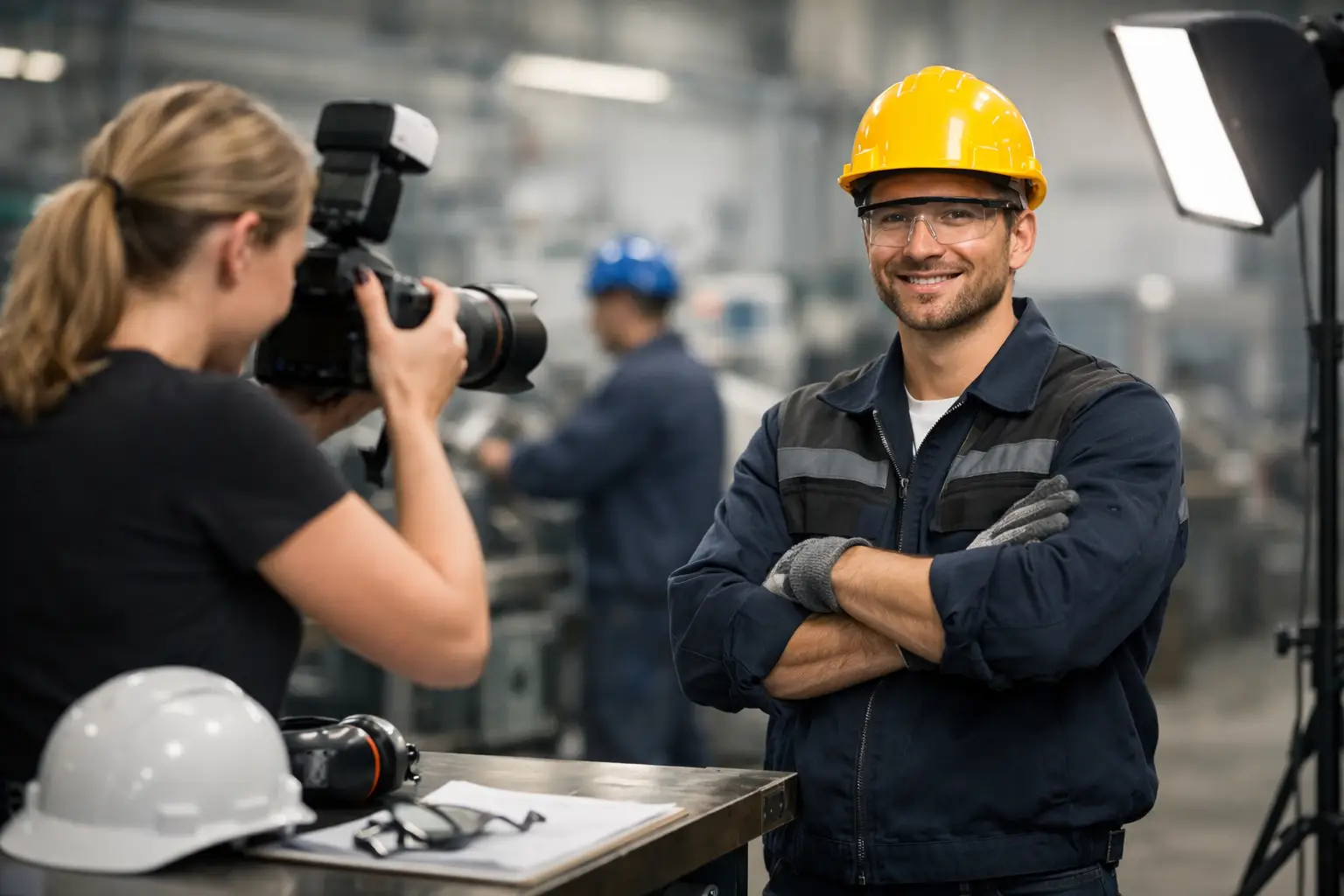
Communicate in advance. Explain the purpose of the shoot, where images may be used, when the photographer will be in their area, and what is expected of participants. Ask team members to arrive in clean, approved workwear with the correct PPE. If branded uniforms are part of your operation, ensure enough clean sizes are available for the people who will be photographed.
Avoid asking employees to smile at the camera while pretending to work. It rarely feels believable. Instead, let people perform familiar tasks, then make modest adjustments to position, pace, or sightline when necessary. A skilled commercial photographer can direct a scene while preserving the natural focus and professionalism of the person in it.
Consider who represents the breadth of your organization. Include a range of roles, experience levels, and departments where appropriate. If your goal is recruitment, show mentorship, collaboration, modern equipment, and work that appears purposeful. If your goal is customer confidence, focus on precision, inspection, technical knowledge, and reliable execution.
Protect Production Time With a Realistic Schedule
A factory photo day works best when it is designed around operations, not imposed on them. Map the production schedule with department leads and determine which processes must be captured at a particular time. This may include material delivery, shift change, machining, assembly, testing, packaging, or final inspection.
Allow more time than expected for access, PPE changes, equipment setup, and moving between departments. Industrial environments are visually rich but logistically demanding. A ten-minute walk-through can become a thirty-minute transition when a production zone requires an escort or an operator needs to finish a cycle before the scene can be photographed.
Plan the most critical shots early, when the facility, people, and schedule have the most energy. Reserve secondary images, portraits, and detail shots for later in the day. If a production delay occurs, the photographer can shift to another prepared location rather than waiting without a useful alternative.
Lighting is another scheduling consideration. Natural light may improve exterior views, loading bays, offices, and spaces with large windows, while production areas often require a controlled lighting approach to manage mixed color temperatures, reflective metals, and dark machinery. Discuss these conditions during the pre-production walk-through so the crew arrives with the right equipment and expectations.
Make Room for the Images You Did Not Plan
The shot list protects your priorities, but it should not prevent discovery. Some of the most effective commercial images happen between planned setups: a supervisor reviewing a component with an operator, a forklift moving through a dramatic aisle, or a close-up that reveals the texture and precision of a finished part.
Give the photographer enough access to observe the rhythm of the operation. At Image Calgary, collaboration is the key to creativity, and the people closest to the work often know where the most compelling moments happen. A brief conversation with an operator can reveal a process, tool, or quality check that deserves to become part of the visual story.
When photo day is well prepared, the camera does not simply record a facility. It shows evidence of care, capability, and the people who make the work possible. That is the kind of image library that continues to earn its place across your brand long after the production floor returns to its normal pace.