
A polished campaign image can now be generated in seconds, but that does not mean it can replace the photograph of your actual team, facility, product, or customer experience. AI commercial photography trends are changing how brands plan and produce visual content, yet the most effective work still begins with a clear understanding of the brand story.
For marketing teams, the question is no longer whether AI will affect commercial photography. It already has. The more useful question is where it improves creative efficiency, where it introduces risk, and where authentic photography remains the strongest commercial choice.
AI Commercial Photography Trends Shaping Brand Content
The biggest shift is not a move away from photography. It is a move toward hybrid production. Brands are using AI to support concept development, previsualization, image selection, retouching, and asset adaptation, while relying on professionally produced photography for the people, places, products, and moments that need to feel credible.
This distinction matters. A stock-style image may fill a layout, but it rarely communicates what makes a business different. A real portrait of a leadership team, a precise image of a manufacturing process, or an inviting photograph of a restaurant’s signature dish gives customers evidence. It shows that the brand is established, accessible, and confident in its work.
AI-assisted concepting gets more specific
Creative teams are increasingly using generative tools to test visual directions before a shoot. They can explore a lighting mood, color treatment, set design, wardrobe direction, or campaign composition without committing production resources too early. For a national campaign or a detailed product launch, this can make early-stage conversations more efficient.
Used well, these references help photographers, art directors, and clients align on intent. They are not a substitute for a creative brief. AI can produce an attractive concept quickly, but it does not know which details are central to your positioning, which customer concerns matter most, or what visual territory your competitors already occupy.
The best approach is to use AI sketches as a starting point, then build a shoot around the real qualities of the brand. Collaboration is still the key to creativity because someone needs to make the strategic decisions behind the image.
Production planning becomes faster
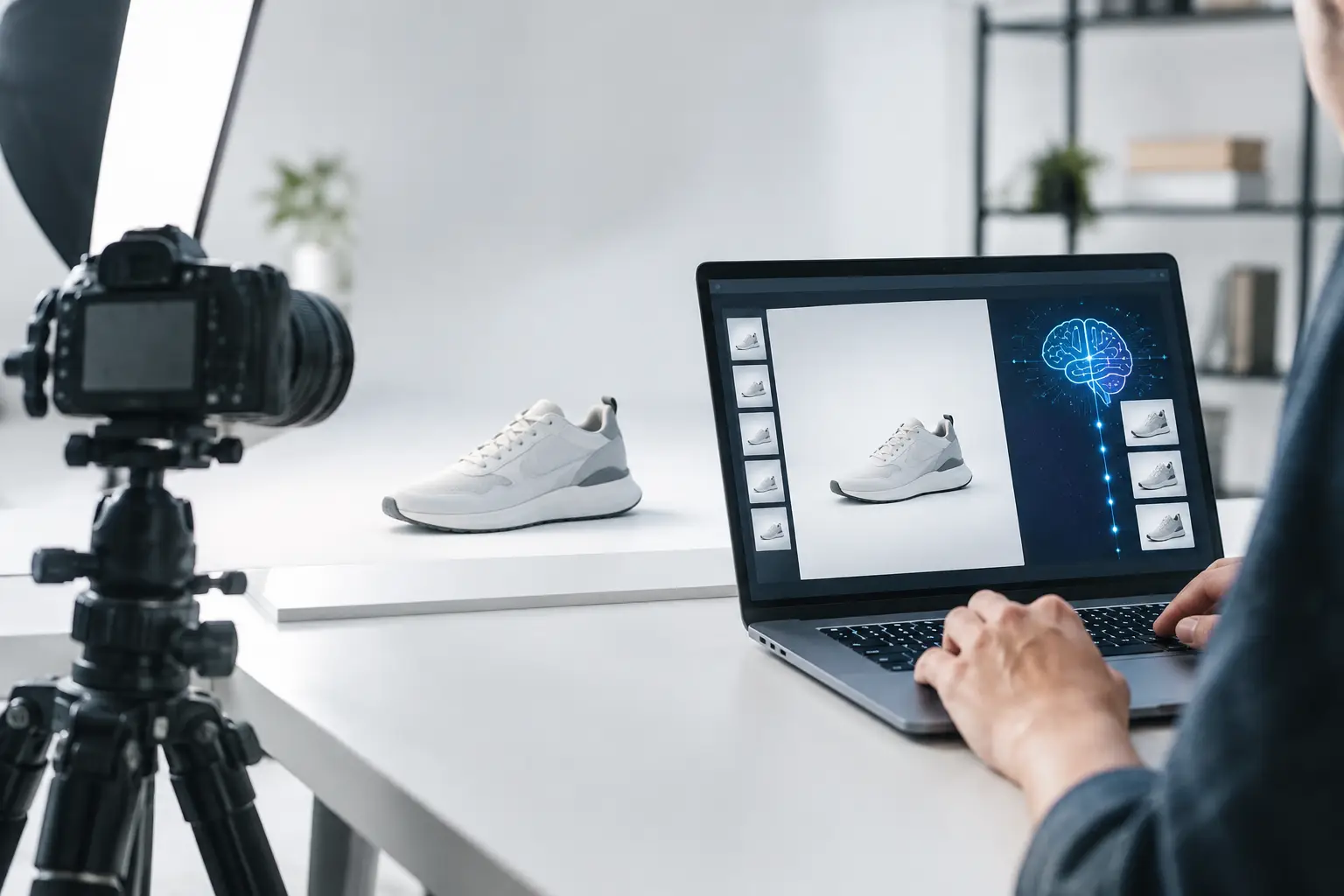
Commercial shoots involve more than a camera and a location. There are schedules, site considerations, safety requirements, talent needs, prop styling, shot priorities, approvals, and contingency plans. AI tools can help organize shot lists, identify production questions, generate early location mockups, and reduce time spent on repetitive administrative tasks.
For industrial, architectural, food, and lifestyle photography, this planning support can be particularly valuable. A production team can arrive better prepared, with more time reserved for the details that affect the final image: the quality of light, a clean composition, a natural expression, or the exact angle that gives a product presence.
Efficiency should not be confused with automation for its own sake. A rushed shoot with an AI-generated shot list is still a rushed shoot. Technology creates value when it gives the creative team more room to observe, direct, and solve problems on set.
Real People and Real Places Are a Competitive Advantage
As generated imagery becomes easier to create, authenticity becomes more visible. Audiences may not always identify an AI image immediately, but they often sense when a visual feels generic, overly polished, or disconnected from reality. That response can weaken trust, especially in sectors where credibility influences purchasing decisions.
For professional services, health care, construction, manufacturing, hospitality, and corporate communications, real photography carries weight. Customers want to see who they will work with, what the environment looks like, and how the organization operates. A generated image of a smiling technician may look clean, but it cannot show the expertise, culture, equipment, or standards of your actual business.
This does not mean every image needs to be documentary in style. Commercial photography can be carefully styled, art directed, and retouched while remaining truthful. The goal is not rawness. The goal is visual confidence rooted in something real.
Product accuracy is non-negotiable
AI-generated product imagery is one of the areas where brands need the most caution. Generated visuals can alter proportions, materials, labels, packaging, finishes, and functional details. Those changes may be subtle, but they can create problems when customers expect the image to represent what they will receive.
For consumer products, food and beverage, equipment, and technical products, professional photography offers control. The photographer can accurately represent texture, scale, color, and use while still making the product look aspirational. AI can assist with background extensions, conceptual environments, or alternate formats, but the hero product should be grounded in reality.
There is also a brand consistency issue. When a product is photographed within a defined visual system, future campaigns can reproduce the same lighting, styling, and point of view. Random generated outputs make that consistency harder to maintain.
Postproduction Is Becoming More Flexible
Many of the most practical AI commercial photography trends are happening after the shoot. Intelligent masking, cleanup, background refinement, noise reduction, resolution enhancement, and versioning can reduce repetitive editing time. This can be useful when a campaign needs multiple crops, formats, or regional variations.
The benefit is not simply speed. It is the ability to preserve creative attention for the work that needs judgment. A retoucher can spend less time on basic selection tasks and more time refining skin tones, balancing a scene, protecting product accuracy, and maintaining a natural final result.
There is a limit. Aggressive AI retouching can make people look unfamiliar, workplaces look unreal, and materials look synthetic. Brands should establish clear standards for what may be altered and what must remain true to the subject. This is especially important for portraits, editorial work, regulated industries, and any campaign built around trust.
Ownership, Disclosure, and Brand Risk Need Attention
Generated imagery raises questions that go beyond appearance. Businesses should understand how a tool handles prompts, uploaded reference images, training data, licensing, and commercial usage rights. A visually compelling image is not useful if its ownership is unclear or if it exposes the brand to legal or reputational concerns.
Teams should also consider when disclosure is appropriate. If an image represents a real location, person, product, or event but was substantially generated, using it without context can create confusion. The right policy depends on the industry and application, but transparency is often the safer choice when the visual could affect customer expectations.
A commercial photographer and creative partner can help assess these choices before assets reach a campaign. The objective is not to avoid new tools. It is to protect the integrity of the brand while using them thoughtfully.
The Strongest Strategy Is a Deliberate Mix
AI is most useful when it supports a visual strategy rather than setting one. Use it to explore directions, streamline preparation, create nonliteral supporting visuals, and adapt approved assets. Invest in original photography when the image needs to establish trust, document capability, introduce people, represent a product accurately, or create a lasting library of brand-owned content.
That mix will look different for every organization. A restaurant may need richly photographed menu items and interiors, with AI helping test seasonal campaign ideas. An industrial company may prioritize real sites, crews, and equipment, while using AI to visualize an unbuilt future facility. A professional service firm may rely on authentic portraits and office imagery, then use intelligent editing to extend the value of each shoot.
The brands that stand out will not be the ones using AI most visibly. They will be the ones making sharper choices about what their audience needs to see, believe, and remember. Start there, and let every tool serve the story you are trying to tell.