

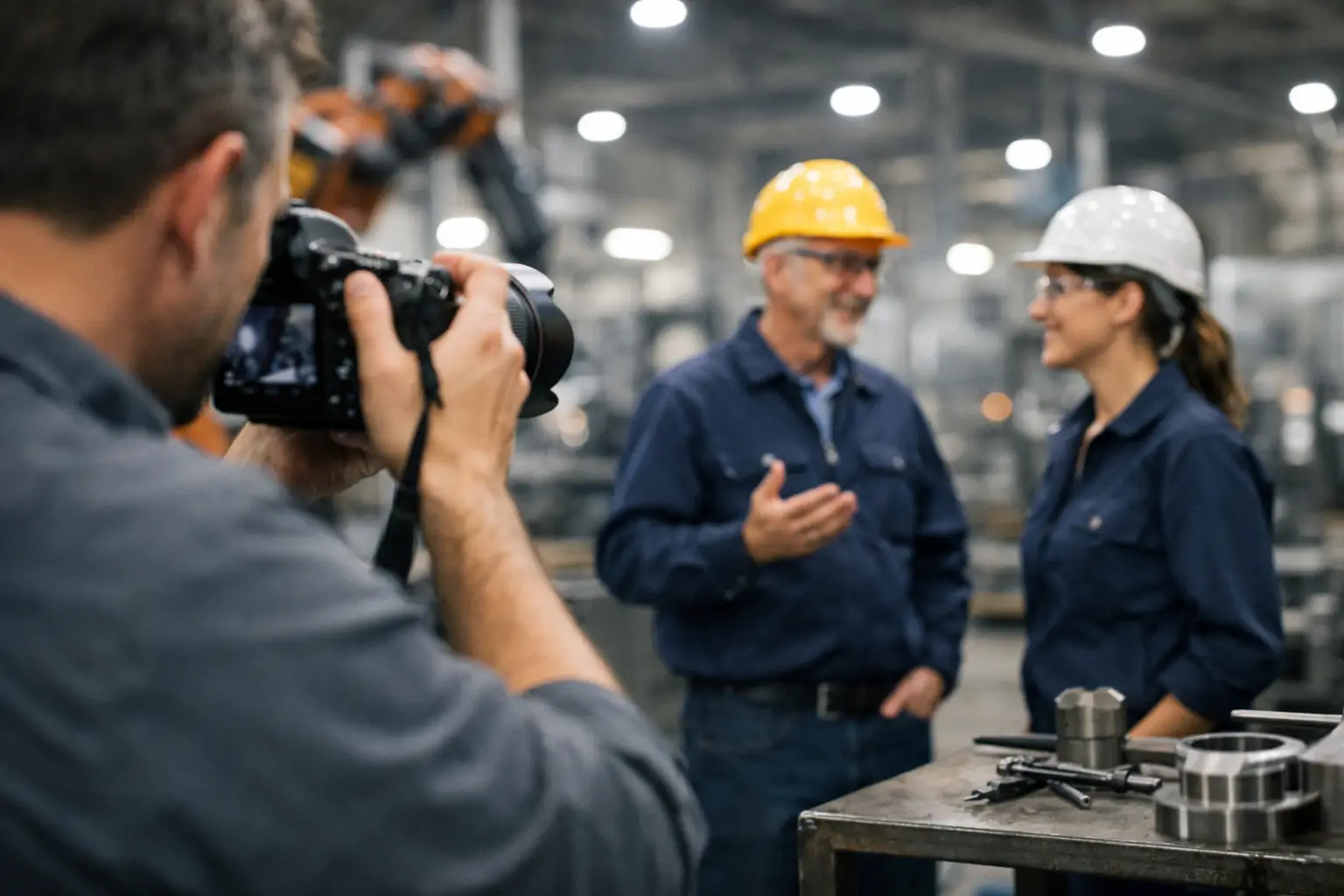
A manufacturing facility can represent years of investment, specialized expertise, and hard-won operational discipline. Yet many companies still rely on dated images, generic stock photography, or quick snapshots that fail to show what makes their operation credible. Manufacturing facility photography changes that by making the scale, precision, people, and purpose of the work visible.
For industrial businesses, photography is not simply documentation. It is evidence. Strong images can help a prospective customer understand your capabilities before a sales conversation begins. They can support recruitment, strengthen a proposal, bring authority to an annual report, and give your website the visual confidence expected from a serious manufacturer.
What Manufacturing Facility Photography Should Communicate
The strongest industrial imagery does more than show machinery on a production floor. It tells a clear story about how your business works and why customers should trust it. That may mean showing exacting quality-control procedures, experienced employees at work, specialized fabrication equipment, clean process flow, or the physical scale of a facility that is difficult to explain in words.
Every manufacturer has a different visual advantage. A precision machining company may need close, controlled images of tolerances, tools, and finished components. A food manufacturer may need to demonstrate cleanliness, consistency, and care. A large-scale producer may need aerial perspectives and wide environmental images that establish capacity. The right creative direction depends on the audience and the business objective, not on a one-size-fits-all industrial look.
The human element matters just as much. Buyers want to know that capable people stand behind the products they purchase. Images of engineers, operators, supervisors, and quality teams can communicate experience in a way a facility-only image cannot. When photographed with intention, these moments feel authentic rather than staged, and they give the brand a face.
Start With the Brand Story, Not the Shot List
A shot list is useful, but it should not be the starting point. Before planning a production, define what the images need to achieve. Are you positioning the company for larger contracts? Updating an outdated website? Recruiting skilled tradespeople? Introducing a new product line? Preparing materials for an investor presentation, trade show, or media opportunity?
These goals influence every creative choice. A recruitment campaign may prioritize team portraits, training, collaboration, and a workplace that looks safe and well organized. A sales-focused campaign may give more attention to technical capabilities, product detail, production capacity, and the stages of a process that differentiate your operation from competitors.
Collaboration is the key to creativity. The most useful planning conversations often involve marketing, operations, health and safety, and the people who understand the production line best. Together, they can identify the moments that are visually compelling, operationally accurate, and commercially valuable.
This process also prevents a common issue: producing attractive images that cannot be used in the places where they matter most. A website banner needs generous negative space for copy. A vertical social campaign needs a different composition than a trade publication spread. A library of images should account for these needs from the beginning, giving your team more flexibility after the shoot.
Planning a Manufacturing Photography Shoot
Industrial photography succeeds when creative planning and facility logistics receive equal attention. Production environments move quickly, and the photography process should respect that reality. A professional photographer will work with your team to map the facility, understand access requirements, identify key processes, and schedule images around production demands.
Safety comes first. Personal protective equipment, visitor orientation, restricted zones, sanitation procedures, and equipment lockout requirements must be understood before cameras come out. A photographer should never create disruption or encourage employees to work in a way that conflicts with established safety practices just to get a more dramatic frame.
Lighting is another practical consideration. Manufacturing facilities often combine overhead industrial lighting, bright windows, reflective metal, welding arcs, screens, and shadowed areas. Those conditions can be visually rich, but they require technical control. Supplementary lighting may be used to shape a portrait, reveal product detail, or create separation within a busy scene. In other cases, available light is the better choice because it preserves the atmosphere of the work.
The trade-off is authenticity versus polish, and the best answer is usually a balance. A completely uncontrolled image can look flat or cluttered. An overly constructed image can make a working facility feel artificial. The goal is to create photographs that are refined enough for a major campaign while remaining true to the operation employees and customers recognize.
Prepare the Floor Without Making It Look Unreal
A full facility cleanup is rarely necessary, and it can be counterproductive if it erases the character of real work. Still, a focused visual review can make a major difference. Remove outdated signage, loose packaging, personal clutter, obsolete materials, and anything that may create confusion about the process or brand.
Coordinate branded uniforms and confirm that PPE is correct and in good condition. Check labels, screens, whiteboards, and paperwork for confidential information. If a product is being featured, ensure the best available version is ready, clean, and positioned at the appropriate stage of production.
A few small details can protect a significant investment in photography. They also make it easier for the photographer to focus on timing, composition, and the genuine moments that cannot be recreated later.
The Images Your Team Will Use Most
A complete manufacturing image library should give your organization options. It should include wide facility views that establish place, medium images that show people and processes in context, and close details that communicate materials, craftsmanship, technology, or quality.
Leadership portraits, environmental employee portraits, product images, shipping and logistics scenes, and exterior architecture may also be valuable. For some businesses, aerial photography provides the clearest view of facility scale, site access, rail connections, storage capacity, or the relationship between multiple buildings. For others, the most persuasive image may be a technician making a careful adjustment that reflects the company’s entire approach to quality.
Variety matters because audiences encounter your brand in different ways. A procurement manager may see one image in a capabilities deck. A candidate may see another on a careers page. A current customer may encounter an image in a company announcement. When these visuals share a consistent level of quality and a coherent point of view, they reinforce the same message: this is an organization that knows its work and presents it with confidence.
Make the Investment Work Beyond Launch Day
Photography delivers more value when it is planned as a long-term brand asset rather than a single campaign expense. Before the shoot, identify the channels that need imagery now and the likely needs ahead. This helps determine the right mix of horizontal, vertical, wide, and detailed compositions.
Afterward, use the final image library across your website, proposals, presentations, recruiting materials, case studies, media kits, social content, and internal communications. A strong collection also gives agencies and marketing teams a credible foundation for future design work, reducing the temptation to fill important spaces with stock imagery that could belong to any company.
It is worth revisiting the facility as operations evolve. New equipment, expanded capabilities, improved workflows, and team growth are visual proof points. Regular photography updates keep your brand aligned with the business you have become, rather than the business you were several years ago.
For companies throughout Calgary and Western Canada, Image Calgary approaches industrial work as both a creative assignment and a business conversation. Understanding your brand story is the first step to creating images that feel distinctive, useful, and true to the work happening inside your walls.
The most effective facility photographs do not ask viewers to imagine your capabilities. They let them see the care, expertise, and momentum behind them.