

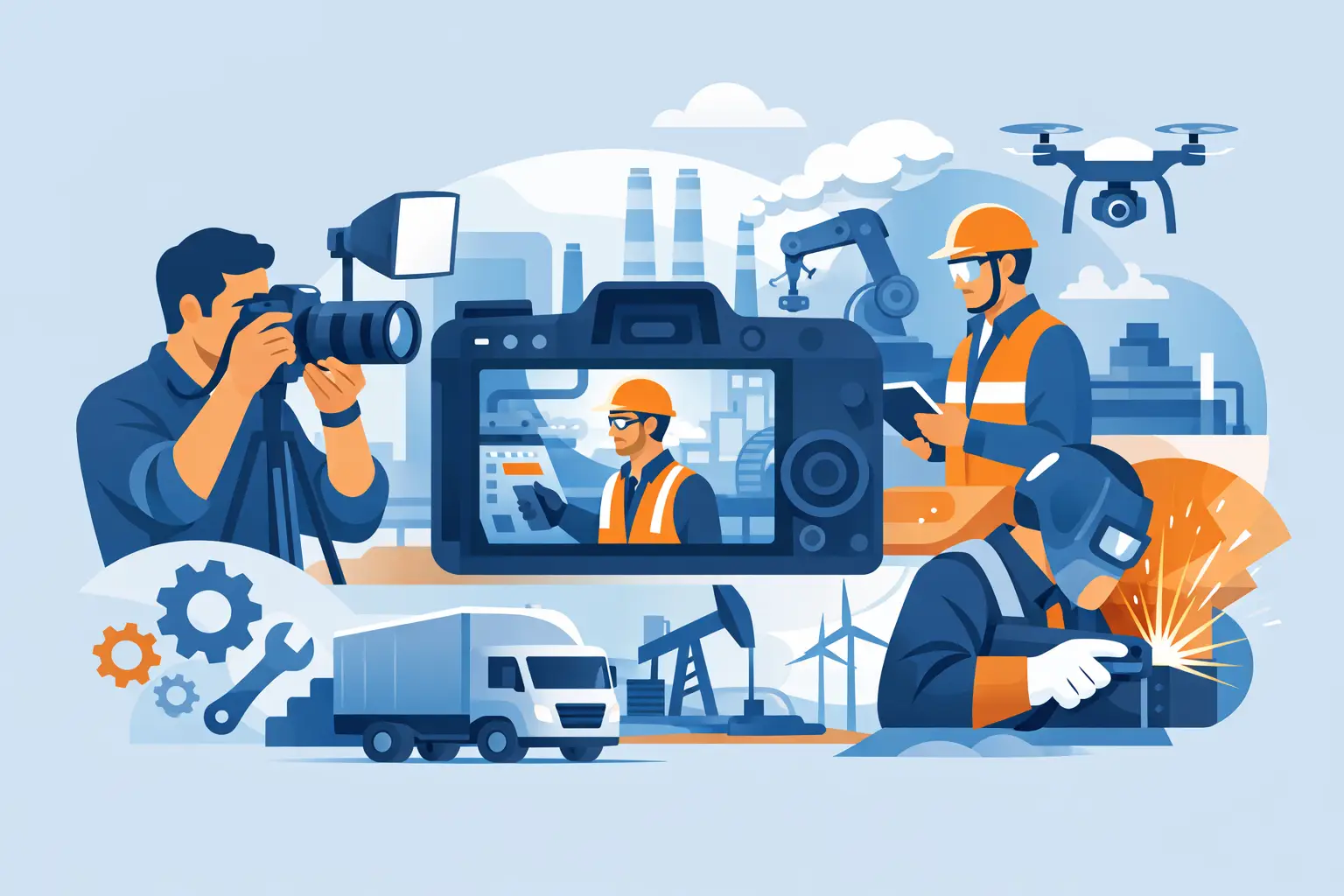
A wide production floor, a fabrication crew mid-process, a logistics team moving with precision – these are not just operational scenes. In the right hands, they become proof of capability. That is what strong industrial photography services are really built to deliver: imagery that shows how your business works, why it matters, and what sets it apart in a competitive market.
For industrial companies, generic visuals create an immediate credibility gap. Stock photos rarely reflect the complexity of real operations, the standards your team follows, or the scale of your environment. When your website, proposals, recruitment materials, and corporate communications all rely on weak or outdated imagery, your brand loses authority before a conversation even begins.
Industrial photography has to do more than document equipment and facilities. It needs to translate technical work into clear visual communication for customers, investors, partners, and future employees. That takes planning, brand awareness, and a strong understanding of how industrial businesses actually present themselves in the market.
What industrial photography services are really buying you
At a surface level, you are hiring a photographer to capture a site, a process, or a team. At a business level, you are investing in visual assets that shape perception. Those are two very different things.
The best industrial photography services create images that work across multiple business needs. A single production shoot might support your website, pitch decks, trade show graphics, annual reports, social content, recruitment campaigns, and editorial placements. That flexibility matters because industrial shoots often involve coordination around safety protocols, production schedules, site access, and staff availability. If you are taking the time to do it properly, the imagery should carry value well beyond one immediate use.
This is where strategy changes the outcome. A technically sharp image of a machine is not always a useful brand image. Sometimes the stronger frame includes the operator, the environment, and a visible sense of process. Sometimes the most effective photo is not the largest piece of equipment, but a detail that communicates precision, standards, or craftsmanship. The goal is not to photograph everything. The goal is to photograph what your audience needs to believe.
Why industrial environments need a different approach
Industrial spaces are visually demanding. Lighting is unpredictable, sites are active, and not every environment is naturally camera-friendly. There may be reflective surfaces, heavy shadows, cluttered backgrounds, PPE requirements, weather exposure, or restricted access to key areas. A photographer working in this setting needs more than technical control. They need judgment.
That judgment affects every frame. Should the image emphasize scale or efficiency? Is the priority to show human expertise or automated systems? Does the client need a gritty, high-energy visual style, or a cleaner, more polished look that aligns with a broader corporate brand? It depends on the audience and the use case.
An oil and gas supplier, a manufacturing company, a construction firm, and a logistics operator may all fall under the industrial umbrella, but they should not all look the same. Their imagery should reflect their actual brand position. Some businesses want to lead with innovation. Others need to highlight reliability, safety culture, or workforce strength. Good industrial photography starts by understanding that difference.
What the strongest industrial images communicate
The most effective industrial imagery tends to communicate four things clearly: competence, scale, safety, and people.
Competence is often the first priority. Buyers want to know that your operation is organized, experienced, and equipped to deliver. Images of active systems, skilled employees, and well-maintained environments help reinforce that.
Scale is equally important, but it should be used with intention. Wide shots of facilities, yards, plants, and infrastructure can establish operational capacity quickly. Still, scale alone can feel impersonal. It becomes more powerful when paired with context, whether that is a team at work, a product in motion, or a process being executed with precision.
Safety matters because industrial brands are judged on professionalism as much as output. Careless imagery can damage trust fast. Missing PPE, staged moments that feel unrealistic, or visuals that ignore actual site standards send the wrong message. Strong photography respects the environment it is documenting and shows that your business takes its responsibilities seriously.
Then there are the people. This is where many industrial brands miss an opportunity. Equipment may impress, but people build trust. A welder focused on a task, a supervisor reviewing a system, a technician calibrating machinery – these moments turn an operation into a story. They give clients and stakeholders something to connect with beyond infrastructure.
The difference between documentation and brand storytelling
There is a place for straightforward documentation. You may need clean records of equipment, facilities, vehicles, or specific project milestones. Those images are useful. But if every image functions only as a record, your brand presentation can feel flat.
Brand storytelling in an industrial setting does not mean making the work look glamorous or overproduced. It means finding the visual through-line that expresses who you are as a business. That could be craftsmanship, innovation, discipline, scale, sustainability, or team culture. The story should be real, but it should also be deliberate.
This is often where collaboration makes the biggest difference. When a photography team understands your brand, they can plan for the images that matter most instead of simply reacting on-site. They can identify the moments that support your messaging, your market position, and your future content needs.
At Image Calgary, that collaborative thinking is central to the process. The goal is not to walk away with a folder full of images. It is to create visual content that supports how a business wants to be seen.
How to evaluate industrial photography services
If you are comparing providers, the portfolio is only one part of the decision. You also want to understand how they think.
A strong industrial photographer should be able to talk about pre-production, site coordination, safety awareness, shot planning, and end use. They should ask about your audience, your brand standards, and where the imagery will appear. If the conversation begins and ends with camera gear or hourly rates, that is usually a sign that the work is being treated as a simple photo assignment rather than a business asset.
It is also worth paying attention to range. Industrial businesses rarely need only one kind of image. They may need environmental portraits, facility exteriors, detailed process shots, team imagery, aerial views, and campaign-ready brand visuals from the same production window. A photographer who can move confidently across those needs will give you a stronger, more usable library.
That said, more images is not always better. Coverage without clarity can create a bloated gallery and a weak final set. What matters is whether the visuals are purposeful, consistent, and aligned with how your business needs to present itself.
Planning makes the shoot better and the images more useful
The quality of an industrial shoot is often decided before the camera comes out. A clear shot list, a realistic production schedule, and internal coordination with operations teams can dramatically improve the result.
That preparation helps solve common problems. It reduces downtime on-site, avoids missed access windows, and makes it easier to capture real activity without disrupting the work. It also gives the photography team the context needed to prioritize the images with the highest long-term value.
In many cases, the most useful question is not, what should we photograph? It is, what do we need these images to do? Once that is clear, decisions around location, timing, staffing, styling, and visual direction become much easier.
Industrial businesses do not need photography that simply proves they exist. They need imagery that shows why they are credible, capable, and worth choosing. When the visuals are built around brand story as well as operational reality, they become more than documentation. They become part of how your business earns trust before anyone picks up the phone.
If your company is investing in new photography, aim higher than coverage. Build a visual library that works as hard as your team does.