
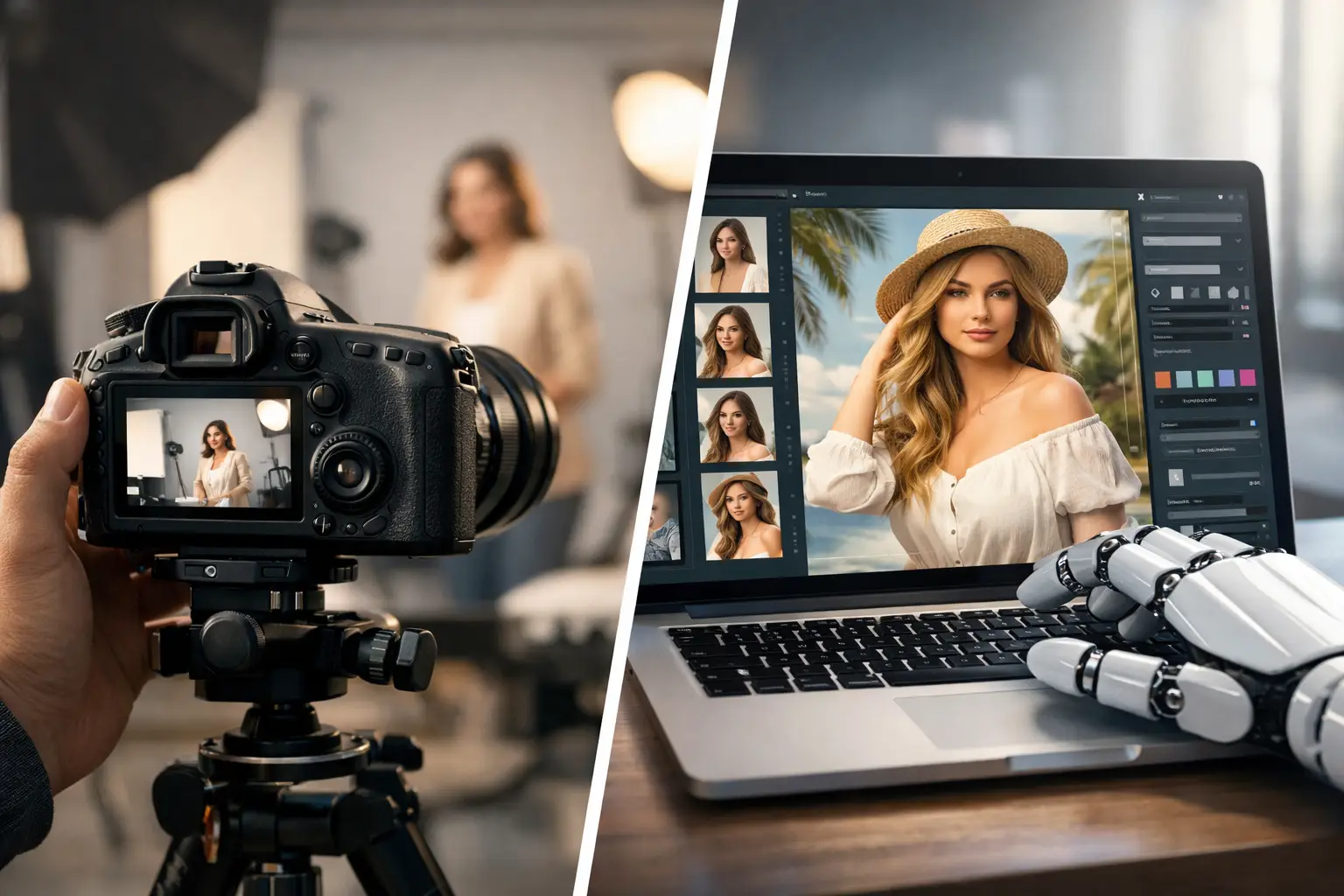
A website visitor may not be able to explain why an image feels manufactured, but they often sense it before they read a word. That instinct sits at the center of the professional photography vs AI images conversation. For brands, the choice is not simply about speed or cost. It is about what the image asks an audience to believe.
AI can produce a polished scene in seconds: a cheerful team in a bright office, a plated meal beside a sunlit window, a worker in safety gear on an industrial site. Professional photography captures something more difficult to fabricate – your actual people, product, place, and standards. Both have a place in modern marketing, but they do not carry the same commercial weight.
What Each Option Actually Delivers
AI-generated images are created from prompts, reference material, and trained visual patterns. They are useful for visual exploration, mood boards, early campaign concepts, abstract illustrations, and situations where no factual claim is being made. With the right direction, they can help a team test a color palette, compose a social post, or make an idea tangible before a production begins.
Professional photography is a planned process of translating a brand story into original assets. It includes creative direction, location choices, styling, lighting, composition, talent guidance, and post-production. More importantly, it begins with context. A photographer can understand what makes a facility impressive, what customers need to see in a product, and what makes a leadership team approachable rather than generic.
That difference matters when the image is expected to represent reality. A law firm should not fill its site with invented attorneys. A restaurant should not promote a dish that a guest cannot order. An industrial company should not show equipment, controls, or safety procedures that do not exist on its site.
Professional Photography vs AI Images: The Trust Test
Trust is a business asset, especially in industries where buyers are making considered decisions. Clients evaluating a construction partner, healthcare provider, manufacturer, financial advisor, or B2B service firm look for evidence of capability. Images of real people doing real work provide that evidence quickly.
A well-produced environmental portrait says, “These are the people behind the promise.” A detailed photograph of a process, facility, or finished project says, “We do this work, and we are proud to show it.” Those messages are difficult to recreate with a prompt because their value comes from verification as much as visual appeal.
AI imagery can also create a subtle credibility problem when it is almost believable but not quite. Hands, reflections, logos, product labels, tools, architectural details, and background activity may look plausible at first glance while falling apart under closer review. For a brand that has invested years in its reputation, that small disconnect can make the whole presentation feel less considered.
This does not mean every marketing image must be documentary. Creative photography can be highly styled, conceptual, and cinematic. The distinction is that the final asset is built around the truth of the brand, not a visual approximation of it.
Brand Consistency Requires More Than a Good Prompt
A strong brand image is not only attractive. It is recognizable. The tone of the lighting, use of color, pace of a shoot, choice of locations, casting, styling, and composition all work together to create a consistent visual language.
AI platforms can imitate a broad aesthetic, but maintaining that aesthetic across dozens of images is less straightforward. A generated team may change faces from one image to the next. A product may shift shape, scale, or label design. An interior may contain different fixtures every time it appears. These inconsistencies may be minor in a one-off social graphic, but they become visible across a website, proposal, annual report, campaign, and recruitment materials.
Professional photography gives a brand a library of connected assets. The same lighting approach can move from executive portraits to workplace imagery. Product photos can be created with the right angles and negative space for ad layouts. Food and beverage imagery can align with the atmosphere guests will encounter in person. Aerial photography can show the true scale of a site or development.
The result is not just a set of photographs. It is a flexible visual system that can support marketing long after the first campaign ends.
The Real Cost Is Not Always the Production Budget
AI images can appear to be the low-cost choice, particularly when a team needs content quickly. For low-stakes, conceptual use, that may be true. But the initial generation time is only part of the equation.
Marketing teams often spend additional time writing prompts, reviewing outputs, correcting inaccuracies, editing artifacts, and trying to make unrelated images feel like one campaign. When a generated image needs to show a specific product, branded uniform, location, or customer experience, the revisions can become inefficient. There is also the cost of putting an image into market that creates confusion or fails to reflect the business accurately.
Professional photography requires a higher upfront investment because it involves preparation and production. Yet thoughtful planning makes that investment work harder. A single full-day shoot can create imagery for a website refresh, paid advertising, case studies, social media, recruitment, public relations, presentations, and internal communications.
The most effective question is not, “Which option is cheaper?” It is, “Which option gives this project the right level of credibility, control, and long-term value?”
Where AI Can Support a Photography-Led Strategy
The choice does not need to be absolute. AI is most useful when it supports the creative process rather than replaces the brand’s visual proof.
Before a shoot, it can help explore broad concepts or illustrate a possible art direction. After a shoot, it may be appropriate for background extensions, simple graphic treatments, or clearly conceptual campaign elements, provided the use is transparent and carefully reviewed. It can also help teams create visual placeholders while final assets are being produced.
The key is to use AI where interpretation is acceptable and professional photography where accuracy, emotion, and accountability matter. A conceptual illustration for an article has different requirements than a hero image introducing your leadership team. A stylized background for a presentation is not the same as a photo showing a customer’s product installation.
Every use should also be evaluated for licensing, originality, disclosure requirements, and potential conflicts with brand values. If an image presents a person, a workplace, a product, or a result as real, it should be real.
What Professional Photography Makes Possible
The best commercial photography process is collaborative because no outside creative partner knows a company as well as the people inside it. The photographer’s role is to ask the right questions, identify what is visually distinctive, and shape that information into images an audience can understand immediately.
For a hospitality brand, that may mean capturing the energy of service, signature dishes, and the details that make a space memorable. For an industrial company, it may mean documenting skilled people, precise workflows, equipment, and a culture of safety. For professional services, it can mean moving beyond stiff headshots to create credible portraits and workplace moments that feel capable and human.
This is where photography becomes a commercial tool rather than a decorative expense. It helps prospects picture the experience of working with you. It gives sales and marketing teams material they can use with confidence. It gives a growing organization a visual record of its people and progress.
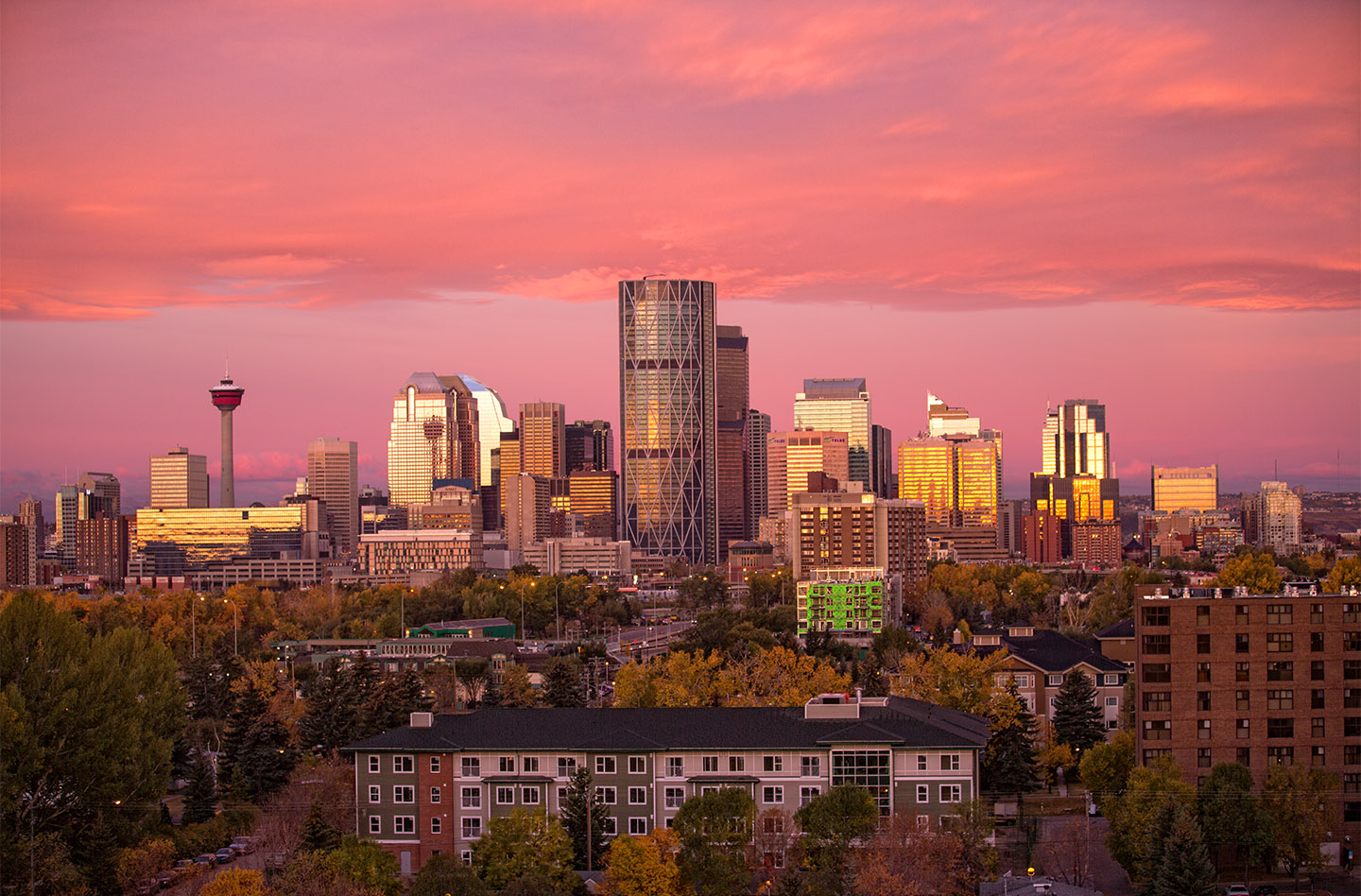
At Image Calgary, collaboration is the key to creativity. Understanding a client’s brand story before the camera comes out helps turn a production day into a purposeful library of visual assets, not a collection of disconnected photos.
Choose Based on the Claim You Are Making
When an image is meant to inspire an idea, AI may offer a fast and useful starting point. When it is meant to prove who you are, what you make, where you work, or how you serve customers, professional photography is the stronger choice.
Your audience is already making decisions about your credibility from the details they see. Give them images that reward that attention – images with real context, real character, and a clear connection to the promise your brand makes.